Dogs are bound to bark. It goes with the territory (no pun intended). Anything new, or suspicious, or stimulating can produce a woof-fest. It's an instinctive, "vestigial" thing (a behavior left over from when dogs were wild). When dogs live in packs, they bark to let each other know where they are; they also bark to let each other know that a stranger is approaching their territory, and to let the interloper know "this seat is taken!"
Dogs will also bark because someone is going away, which leaves the pack one dog less secure. Dogs hate being alone, and when we domesticated them, that meant they hated being without us. Anyway, it's good to try to figure out why your pup is mouthing off, because that will influence how you should address the problem. First of all, you can't cure barking until you have worked on training him in general. To change a behavior, he has to understand the basic deal: do what is asked and you get a reward. It takes a while for him to get it; he'll want to go straight to the reward and forget the obedience part. So be persistent over weeks and months!!!
There are basically two techniques: distraction and reward. Some people say there's also "correction", like electric shock or citronella bark collars. Forget it. Would you stop your infant son's crying by giving him a shock or squirting him in the face with citronella??? Come on, dogs have nerve endings too. Instead of "house of corrections" training, settle on the command you'll use to stop barking, like "no bark!" Use the command as soon as the dog starts to bark; approach him and stare him in the face as you say "no bark!" Put your hand gently but firmly around his snout and repeat the command. When he stops, reward him (food, praise, both...it all works). Distraction can be any benign event that will interest the dog. Throw a ball or otherwise play with him; give him a hug; take him someplace (like out). With Benny, who needs a barker's 12-step program, I bounce a ball and act all excited about it. Most times he forgets what he was barking about.
When you leave the house, don't pay attention to him for 15 minutes before you leave and 15 minutes after you get home. This is counter intuitive but ESSENTIAL! If you make a big deal out of coming or going his anxiety is going to skyrocket! WOOF! WOOF!
Lotsa Dogs Lotsa Fun

The Big Dogs Wait at The Door
Friday, February 25, 2005

Friday, February 18, 2005
Runaway Dogs
In spite of the best care and training, some dogs run away. Sometimes they're frightened and want to get away from something specific, like loud noise (especially an owner yelling at them). Some dogs just yearn to run as far and as fast as they can. And then, sometimes there's something "out there" that they can't resist - like garbage! Beagles and Bassets are known for bolting on trash collection day. They can smell the goodness in the air! I used to have a Cocker Spaniel who raced me to the gate every Friday morning,'cause he knew what goodies all those curbside containers held! Then we'd do this foot thing with him trying to bolt between my legs and me fending him off with my lower extremities. He occasionally won; the good part was that he never got further than my next door neighbor's goodie bags.
What to do when your dog runs away? If you're there and see her go, grab her favorite food or treat and try to get in front of her and lead her to the treat. For example, you can jump in your car and go in the same direction as your dog, but go ahead of her; stop, open the car door, and try to lure her in with the treats. It's best to offer something that smells good. I've used cheese and raw meat in the past.
If that doesn't work, don't continue to pursue your dog. It's likely that he'll get caught up in the chase and go farther away than if you didn't pursue him. Animal control officers and rescue organizations have learned that dogs who are loose will generally stay within a 1 mile radius of where they got loose, unless chased further. So notify the local police, the local animal control officer, animal shelters, and near-by veterinarians and tell them that your dog is running loose. Describe him and any collar or leash attached to him. If he's not found in a few hours, put up lots of posters, with his picture (keep a jpg. photo of your dog on your computer!!); circle around the point where he got loose as you post. The first line on the poster should read REWARD! because that's what gets peoples' attention. And include your home and cell phone numbers, as well as the phone number of your animal control officer.
What to do when your dog runs away? If you're there and see her go, grab her favorite food or treat and try to get in front of her and lead her to the treat. For example, you can jump in your car and go in the same direction as your dog, but go ahead of her; stop, open the car door, and try to lure her in with the treats. It's best to offer something that smells good. I've used cheese and raw meat in the past.
If that doesn't work, don't continue to pursue your dog. It's likely that he'll get caught up in the chase and go farther away than if you didn't pursue him. Animal control officers and rescue organizations have learned that dogs who are loose will generally stay within a 1 mile radius of where they got loose, unless chased further. So notify the local police, the local animal control officer, animal shelters, and near-by veterinarians and tell them that your dog is running loose. Describe him and any collar or leash attached to him. If he's not found in a few hours, put up lots of posters, with his picture (keep a jpg. photo of your dog on your computer!!); circle around the point where he got loose as you post. The first line on the poster should read REWARD! because that's what gets peoples' attention. And include your home and cell phone numbers, as well as the phone number of your animal control officer.
Wednesday, February 09, 2005

Monday, February 07, 2005
Housebreaking
Sometimes the term "housebroken" means you have a dog and he/she has broken your house! My elderly Sheltie, Daphne, has begun to make indoor mistakes on my beautiful Chinese rug in the study. Partly, I think her cues are subtle, and she doesn't have much time 'cause her bladder and bowels aren't as tough as they used to be. So she goes to the door and looks back over her shoulder at me. If I'm not there, or I don't notice right away, she heads for the study. Last Spring I had the Chinese rug professionally cleaned and the guy made me feel guilty about the odor in his shop!
Anyway, I went back to some house training tips that I'll share with you
Anyway, I went back to some house training tips that I'll share with you
- Supervision: young pups and old folks need to be watched more carefully than other dogs.
- Confinement: dogs that are vulnerable (the young and the old) should be taken out before you leave them alone, then confined to a small, safe place. The dog should have enough room to stand up, take a few steps, turn around, stretch.
- Praise, praise and more praise: make a big fuss when the vulnerable ones go outside, as in "good girl, Daphne! Good girl!" Then give a gentle hug and some pats.
- Scheduling: always feed at the same time and don't leave the food down for more than 30 minutes. Feed two meals, morning and evening. Evening should be three to five hours before bedtime.
- Clean, clean, clean: use a product made especially for pet stains, like "Resolve". Buy a stiff brush to be used only for pet clean-up. After picking up, or soaking up urine with paper towels, spray the affected areas and brush vigorously. If you don't do these things the dog will surely pee or poop in the same place again.
Tuesday, February 01, 2005
NAPPS: National Association of Professional Pet Sitters
This weekend (Jan 28-31) I was off to Atlanta (from Boston) for the annual NAPPS conference. It was terrific! There was an unusual ice storm in Atlanta but we holed up in a very nice Sheraton for the conference. There were about 125 petsitters and lots of information was exchanged. I was delighted to spend 3 days with other small business owners, swapping stories and resource hints. NAPPS members come from all over the United States, and it is the most respected professional pet care organization that I know of. While most NAPPS members go to their clients' homes to do pet care, which The Doggie Den doesn't do, we still had lots in common. I found out how others get the word out about their services, especially via veterinarians, pet stores, shelters, and humane societies. In fact, many members volunteer to care for animals at shelters. One woman I met volunteers at a National Wildlife Center in New Jersey where sick and injured wildlife is cared for, then released back into the wild. For more information about NAPPS, or for a list of petsitters in your area, check out www.petsitters.org.
Wednesday, January 12, 2005
Dog Daycare for Exercise!
Your dog's most important needs are good nutrition, regular exercise, and tough-love (discipline with plenty of lovin'). Today I want to talk about dogs and exercise.
It's great if you walk your dog twice a day or more, but most breeds will develop nervous habits if that's all they get. They also get fat, which leads to health problems like heart disease and arthritis. Goldens, Dobermans, Labs, Jack Russells, Shih Tzus, Lhasas, Dalmations, Scotties, Westies, Wheatons, Collies, Cockers, Bulldogs... each breed needs a different amount and kind of exercise, but don't kid yourself, they all need some!
Time after time people tell me their dog gets plenty of exercise - she can go out in the back yard anytime she wants (people with dog doors, or whose kids let the dog out). First of all, make sure she's fenced in!! Some people like invisible electric fences; I hate them with a passion. But that's for another posting. The point is PLEASE don't let your dog outside if you don't have a fenced in area for her. Even if you live in the wilds of Australia. Encounters with wildlife always go badly for somebody, and usually it's your dog. Here in New England, we live side-by-side with hungry coyotes and foxes, as soon as you get out of major metropolitan areas. Even in cities, fights with racoons (who can be very aggressive), and chasing squirrels are activities that harm pets all the time.
Even supposing your dog is safe in your yard, you really don't know what she's doing out there unless you supervise her. So, go ahead, let her out to pee if you're in a rush and there's a fenced-in area. But don't be lazy all the time! Go out with her, encourage her to do her business and praise her. Then throw a ball or a frisbee a few times, or even just play with her. That way you know she's getting the elevated heartbeat and mental stimulation she craves. A few dogs can be depended upon to play by themselves, but they're the exception. Most will come back inside as soon as they can, 'cause they're gregarious. They want to be with their pack (you and your family). Run around with her, play tug of war, whatever. Both of you, go ahead, get off that couch!
But you're exhausted when you get home at night, right? Me too!! So who wants to throw a ball for Benny (whose a ballaholic - doesn't want one throw, wants twenty). The answer is... DAYCARE!!!! Dog daycare is the best thing since sliced bread, providing that you find a place that is clean (no smells!) and has high standards around supervision, handling, and the health of each guest. The very best place if you're anywhere near central Massachusetts is The Doggie Den (www.thedoggieden.net). Our doggie guests play in large indoor areas under constant supervision all day long. We wash down both the play areas and the outdoor area where the guests do their business with a high quality animal quarters disinfectant called Cherry 256. It kills all the parasites, bacteria, and virii that make doggie daycare chancey in less fastidious places. Vets will tell you they're not crazy about daycare 'cause it spreads disease. But not us!! Local vets recommend us because we send dogs with a cough or diarrhea home. I've been trained in doggie first aid, and in the basic symptoms of the most common ailments. Our customers are grateful that we signal any problem right away and recommend a trip to the vet's office. We do not let dogs associate with others if we suspect a communicable disease.
The other thing you want to know about your potential play group or day care is: how much exercise does my Baby really get? At The Doggie Den, our guests are free to play from 9am to 6pm. We open at 7am, and we crate the arrivals or leash them in place until 9am, when everyone is freed for the rest of the day. Be sure to ask if doggie guests are crated or restrained for any part of the day. At The Doggie Den we get constant 'thank you's' from customers whose dogs come home exhausted! And that's what you want. Supervised play for extended periods of time! And there should be comfy bedding available in the play areas so the pups can rest when they want to. At The Doggie Den we give everyone a treat at 1pm, then sit down and encourage them to rest. Just like kids' daycare!
It's great if you walk your dog twice a day or more, but most breeds will develop nervous habits if that's all they get. They also get fat, which leads to health problems like heart disease and arthritis. Goldens, Dobermans, Labs, Jack Russells, Shih Tzus, Lhasas, Dalmations, Scotties, Westies, Wheatons, Collies, Cockers, Bulldogs... each breed needs a different amount and kind of exercise, but don't kid yourself, they all need some!
Time after time people tell me their dog gets plenty of exercise - she can go out in the back yard anytime she wants (people with dog doors, or whose kids let the dog out). First of all, make sure she's fenced in!! Some people like invisible electric fences; I hate them with a passion. But that's for another posting. The point is PLEASE don't let your dog outside if you don't have a fenced in area for her. Even if you live in the wilds of Australia. Encounters with wildlife always go badly for somebody, and usually it's your dog. Here in New England, we live side-by-side with hungry coyotes and foxes, as soon as you get out of major metropolitan areas. Even in cities, fights with racoons (who can be very aggressive), and chasing squirrels are activities that harm pets all the time.
Even supposing your dog is safe in your yard, you really don't know what she's doing out there unless you supervise her. So, go ahead, let her out to pee if you're in a rush and there's a fenced-in area. But don't be lazy all the time! Go out with her, encourage her to do her business and praise her. Then throw a ball or a frisbee a few times, or even just play with her. That way you know she's getting the elevated heartbeat and mental stimulation she craves. A few dogs can be depended upon to play by themselves, but they're the exception. Most will come back inside as soon as they can, 'cause they're gregarious. They want to be with their pack (you and your family). Run around with her, play tug of war, whatever. Both of you, go ahead, get off that couch!
But you're exhausted when you get home at night, right? Me too!! So who wants to throw a ball for Benny (whose a ballaholic - doesn't want one throw, wants twenty). The answer is... DAYCARE!!!! Dog daycare is the best thing since sliced bread, providing that you find a place that is clean (no smells!) and has high standards around supervision, handling, and the health of each guest. The very best place if you're anywhere near central Massachusetts is The Doggie Den (www.thedoggieden.net). Our doggie guests play in large indoor areas under constant supervision all day long. We wash down both the play areas and the outdoor area where the guests do their business with a high quality animal quarters disinfectant called Cherry 256. It kills all the parasites, bacteria, and virii that make doggie daycare chancey in less fastidious places. Vets will tell you they're not crazy about daycare 'cause it spreads disease. But not us!! Local vets recommend us because we send dogs with a cough or diarrhea home. I've been trained in doggie first aid, and in the basic symptoms of the most common ailments. Our customers are grateful that we signal any problem right away and recommend a trip to the vet's office. We do not let dogs associate with others if we suspect a communicable disease.
The other thing you want to know about your potential play group or day care is: how much exercise does my Baby really get? At The Doggie Den, our guests are free to play from 9am to 6pm. We open at 7am, and we crate the arrivals or leash them in place until 9am, when everyone is freed for the rest of the day. Be sure to ask if doggie guests are crated or restrained for any part of the day. At The Doggie Den we get constant 'thank you's' from customers whose dogs come home exhausted! And that's what you want. Supervised play for extended periods of time! And there should be comfy bedding available in the play areas so the pups can rest when they want to. At The Doggie Den we give everyone a treat at 1pm, then sit down and encourage them to rest. Just like kids' daycare!
Monday, January 10, 2005
.jpg)
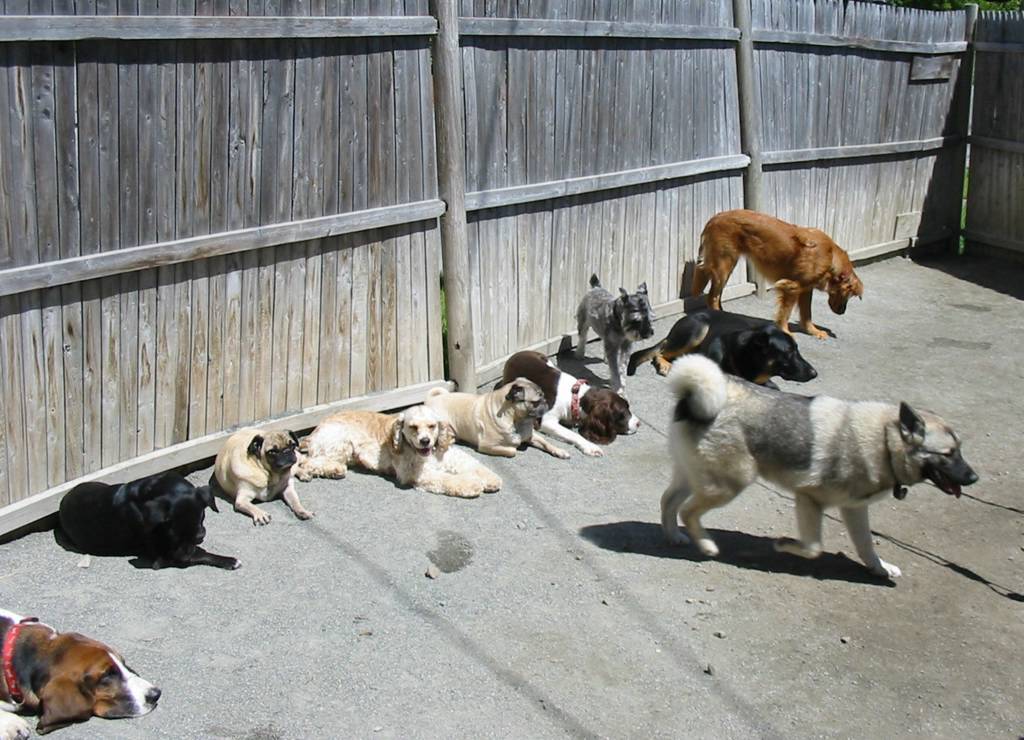

Dogs in the Snow
In January, dog ownership can get complicated. Some pups love the snow, ice, sleet & hail. Lots of pups are more sensible though, and hate it; so how in the world do you get the haters to do their business outside? Even dogs like Huskeys and Malamutes who are bred for snow will sometimes gleefully run through snow piles outdoors, then come into your living room to pee!
First of all, dogs with thin coats need to be covered when it's below freezing, even if they're only out for a brief time. Boxers, Great Danes, Bulldogs, Chihuahuas, Dobermans, Pointers... all the pups with little to no insulation need a warm coat and possibly foot coverings that are made for dogs. Check petedge.com for coats and boots. If you send these dogs out uncovered, the risk is that after a few moments, all they'll think about is how to get back inside. Where they will procede to dump in your study or pee on baby's highchair.
The next problem is where do they go? If you're like most households, snow shoveling and snow blowing have made Fluffy's favorite spot inaccessible. Most likely, she will try to get to her usual place while looking back at you in great perplexity. Little dogs often stare at piles of snow and give up entirely. So it's advisable to keep an outdoor space clear for your dog(s) in the winter. If someone plows your driveway, you can walk the dogs there, giving them a treat when they relieve themselves, so they'll know that the driveway's ok in the winter. Don't worry about poops in your June driveway - dogs prefer dirt, garden, or lawn if they can get to it.
If there's no driveway option, clear a space on your property. I make a circle about 15 feet in diameter just to the side of the porch steps, because like many canines, Benny and Daphne wander in circles when they need to poop. Daphne even does it before she pees. You need a long-handled pooper-scooper set-up so you can clean up after they do their deed, whether they chose your cleared area or the side of a snowpile. It is rare that nature presents a more revolting spectable than a springtime dogpatch that has not been kept clean. I keep a small covered bucket with a trash bag liner in the cleared area. I clean up pee spots too, 'cause I don't want my lawn to go into shock when the snow melts. Once a week the poopy bucket liner goes out with the trash.
If they're having a good time outside, dogs love to eat snow. Not a great idea. We get lots of intestinal infections in Doggie Den Day Care with dogs who have eaten unclean snow. Even in a pristine area, they like to lick snow where other mysterious beings have trod, and moose pee is not necessarily a good nutrient. So have a good time, keep her warm, limit the snow intake, and keep one area clean and clear for when she needs to get serious.
First of all, dogs with thin coats need to be covered when it's below freezing, even if they're only out for a brief time. Boxers, Great Danes, Bulldogs, Chihuahuas, Dobermans, Pointers... all the pups with little to no insulation need a warm coat and possibly foot coverings that are made for dogs. Check petedge.com for coats and boots. If you send these dogs out uncovered, the risk is that after a few moments, all they'll think about is how to get back inside. Where they will procede to dump in your study or pee on baby's highchair.
The next problem is where do they go? If you're like most households, snow shoveling and snow blowing have made Fluffy's favorite spot inaccessible. Most likely, she will try to get to her usual place while looking back at you in great perplexity. Little dogs often stare at piles of snow and give up entirely. So it's advisable to keep an outdoor space clear for your dog(s) in the winter. If someone plows your driveway, you can walk the dogs there, giving them a treat when they relieve themselves, so they'll know that the driveway's ok in the winter. Don't worry about poops in your June driveway - dogs prefer dirt, garden, or lawn if they can get to it.
If there's no driveway option, clear a space on your property. I make a circle about 15 feet in diameter just to the side of the porch steps, because like many canines, Benny and Daphne wander in circles when they need to poop. Daphne even does it before she pees. You need a long-handled pooper-scooper set-up so you can clean up after they do their deed, whether they chose your cleared area or the side of a snowpile. It is rare that nature presents a more revolting spectable than a springtime dogpatch that has not been kept clean. I keep a small covered bucket with a trash bag liner in the cleared area. I clean up pee spots too, 'cause I don't want my lawn to go into shock when the snow melts. Once a week the poopy bucket liner goes out with the trash.
If they're having a good time outside, dogs love to eat snow. Not a great idea. We get lots of intestinal infections in Doggie Den Day Care with dogs who have eaten unclean snow. Even in a pristine area, they like to lick snow where other mysterious beings have trod, and moose pee is not necessarily a good nutrient. So have a good time, keep her warm, limit the snow intake, and keep one area clean and clear for when she needs to get serious.
Friday, January 07, 2005
Dog Bites: Breed-specific Ordinances
Preventing dog bites is an important goal for everyone. Unfortunately, in a world addicted to whatever looks like an easy fix, outraged citizens are asking cities and towns to outlaw certain breeds, thinking that will eliminate, or at least cut down on dog bites.
But this legislative solution is not a solution, because (1)no city or town can effectively enforce such a law and (2)even if the law could be effective, eliminating all the Pit Bulls, Rottweilers, and Dobermans in the world would not address the basic problem: DOG OWNER IRRESPONSIBILITY. Boston recently enacted an ordinance aimed at Pit Bulls and the law has done nothing to reduce the number of dog bites seen in local hospitals and doctors' offices.
What would work, then?
1: Enforcing existing animal control laws, for example. Police can effectively fine people whose dogs run loose, or who walk dogs without a leash. A program of rewards for reporting dogs running loose would help. The key here is to increase funding for animal control!
2: So would mandatory spaying and neutering for all but AKC champions. Only bitches and dogs who have earned their championship should be bred anyway, because the goal should be to improve the temperament, health, and appearance of the breeds. It's highly unlikely that the owner of a champion Staffordshire Terrier (aka "Pit Bull")would breed her or him for killer temperament. If the law obliged veterinarians to report any non-spayed or non-neutered dog to the police, and if owners were fined, there would be fewer intact dogs to cause trouble. Intact male dogs represent 80% of dogs presented to veterinary behaviorists for dominance aggression, and are involved in 70%-76% of reported dog bites in Massachusetts.
But dog bites are only preventable in situations where owners act responsibly. All dogs need appropriate restraint, socialization, obedience training, and safe public areas in which to exercise (dog parks). Dogs and children (especially babies) need very close supervision. A child's attempt to cuddle the family dog can easily result in frightening the animal, and thus put the child at risk of a bite.
As for those who WANT dangerous dogs, they will find them - or create them through deliberate cruelty. Such people should be shot and fed to their dangerous animals.
But this legislative solution is not a solution, because (1)no city or town can effectively enforce such a law and (2)even if the law could be effective, eliminating all the Pit Bulls, Rottweilers, and Dobermans in the world would not address the basic problem: DOG OWNER IRRESPONSIBILITY. Boston recently enacted an ordinance aimed at Pit Bulls and the law has done nothing to reduce the number of dog bites seen in local hospitals and doctors' offices.
What would work, then?
1: Enforcing existing animal control laws, for example. Police can effectively fine people whose dogs run loose, or who walk dogs without a leash. A program of rewards for reporting dogs running loose would help. The key here is to increase funding for animal control!
2: So would mandatory spaying and neutering for all but AKC champions. Only bitches and dogs who have earned their championship should be bred anyway, because the goal should be to improve the temperament, health, and appearance of the breeds. It's highly unlikely that the owner of a champion Staffordshire Terrier (aka "Pit Bull")would breed her or him for killer temperament. If the law obliged veterinarians to report any non-spayed or non-neutered dog to the police, and if owners were fined, there would be fewer intact dogs to cause trouble. Intact male dogs represent 80% of dogs presented to veterinary behaviorists for dominance aggression, and are involved in 70%-76% of reported dog bites in Massachusetts.
But dog bites are only preventable in situations where owners act responsibly. All dogs need appropriate restraint, socialization, obedience training, and safe public areas in which to exercise (dog parks). Dogs and children (especially babies) need very close supervision. A child's attempt to cuddle the family dog can easily result in frightening the animal, and thus put the child at risk of a bite.
As for those who WANT dangerous dogs, they will find them - or create them through deliberate cruelty. Such people should be shot and fed to their dangerous animals.
Tuesday, January 04, 2005
Back on Track, Jack
Back to work on a "normal" schedule and the pups sense the change. At The Doggie Den, in our day care operation, those who took some vacation are over-the-top barky and crazed to be back. The ones who didn't are glad to see their friends and want to play non-stop. Some have diarrhea from sneaking forbidden holiday treats. At home, Daphne and Benny look at me as though I've lost my mind when I try to corral them into the van to go to work. They were perfectly happy being stay-at-home pets over each of the holiday weekends. Now they have to share me with the hordes again, and they're not happy. Daphne scratches my leg when I walk by at work; if that doesn't work, she grabs my pantleg with her teeth! No dummy she. The amount of lovin' she got over the holiday weekends was just fine, thanks, but why stop? Benny has regressed to displaying his aggressive, snarly mug whenever I greet another dog. He flew off the day care couch to kill a large Golden I was patting (remember, Benny is a small Cocker Spaniel) and almost broke his jaw... smack! on the floor. The Golden thought him a bit eccentric, but seemed unconcerned.
Unseasonably warm weather in Massachusetts and the outdoor area has turned to mud. The dogs love it. They lie down in the mud, sometimes even roll over; they chase each other around so their paws are coated, then leap onto the couches, which look like they do in the Spring, during the real mud season. This year, we get to do extra cleaning twice... at least! The good news is the heating bills won't cause heart attacks this year.
January is a low exercise time for both people and dogs. So get off the couch and take a fast walk with the pooch. Take him to a playgroup or day care while you go to the gym to work off the holiday goodies. Dogs need healthier lifestyles too!
Unseasonably warm weather in Massachusetts and the outdoor area has turned to mud. The dogs love it. They lie down in the mud, sometimes even roll over; they chase each other around so their paws are coated, then leap onto the couches, which look like they do in the Spring, during the real mud season. This year, we get to do extra cleaning twice... at least! The good news is the heating bills won't cause heart attacks this year.
January is a low exercise time for both people and dogs. So get off the couch and take a fast walk with the pooch. Take him to a playgroup or day care while you go to the gym to work off the holiday goodies. Dogs need healthier lifestyles too!
Tuesday, December 21, 2004
Keep your dog safe over the holidays
It's oh so tempting to slip Fido a bite of Christmas pudding. But no! Dogs' digestive systems are not set up for our rich holiday treats. They cannot digest many of the ingredients that we take for granted, such as chocolate and nuts; and the result is often severe diarrhea. So, don't want to get up at 4am after an evening of holiday cheer? Limit your pup to treats that are intended for her.
In extreme cases chocolate can have a toxic effect on dogs, and even cause death. If Fluffy has consumed half a pound of Fannie Farmers' best, call your veterinarian's emergency number immediately. If somebody goofed and poor Fido is frozen in "the position" in the back yard, stop feeding him roughage. Fast him for 12 hours, but leave plenty of fresh, cool water around, 'cause diarrhea dehydrates a fellow. After that feed him something very bland and smooth for 24 hours, like boiled rice with a little hamburger cooked in for taste. Cottage cheese is a good adder too.
Like kids, our canine companions depend on us to keep them safe from hazardous materials that look like toys. Mistletoe, christmas lights, tinsel, wires, ornaments, poinsettas, and pine needles will all make your pup sick if she chews them. It's also best to put gifts where she can't get at them without your supervision, or crate her if she's allowed in the same room as the tree and gifts. Pet shops carry dog-safe ornaments that you can put on the bottom branches of your tree.
In extreme cases chocolate can have a toxic effect on dogs, and even cause death. If Fluffy has consumed half a pound of Fannie Farmers' best, call your veterinarian's emergency number immediately. If somebody goofed and poor Fido is frozen in "the position" in the back yard, stop feeding him roughage. Fast him for 12 hours, but leave plenty of fresh, cool water around, 'cause diarrhea dehydrates a fellow. After that feed him something very bland and smooth for 24 hours, like boiled rice with a little hamburger cooked in for taste. Cottage cheese is a good adder too.
Like kids, our canine companions depend on us to keep them safe from hazardous materials that look like toys. Mistletoe, christmas lights, tinsel, wires, ornaments, poinsettas, and pine needles will all make your pup sick if she chews them. It's also best to put gifts where she can't get at them without your supervision, or crate her if she's allowed in the same room as the tree and gifts. Pet shops carry dog-safe ornaments that you can put on the bottom branches of your tree.
Monday, December 20, 2004
There are Breeds and Then There are Breeds
People often bring problems and questions to us, wanting advice and answers. 80% of the time it comes down to knowing about your dog's breed or mix of breeds, and training the dog accordingly.
For example, Labrador Retrievers are one of the most popular breeds in the United States, whether yellow, black or chocolate-colored. Because there are lots of labs around, there are lots of lab mixes around too. They're an excellent family dog, but inevitably owners get angry and frustrated with young labs chewing things up. Sadly lots of labs and lab mixes end up in animal shelters (at least, the lucky ones!) in search of a new owner.
Dogs are genetically programmed to do certain things, according to their breed. To stay with the labrador example, they were originally bred to hunt, not in Labrador, but in Newfoundland. Usually two or more dogs were trained to hunt together, finding, flushing out, and retrieving small prey. Hunting dogs in cold climates need hyperactive metabolisms to stay warm while they work. A thick coat would work out fine, like the one a Newfoundland dog has. However, labs were bred to be in and out of the water constantly when the temperature is below freezing. A thick coat couldn't breathe well enough to prevent icing and therefore hypothermia. So labs were bred selectively to produce high metabolisms, short coats and a huge amount of energy. They are extremely hardy and can hunt and retrieve birds for hours at a time without adverse health effects. In fact, they love it!
So, if you take an animal with that programming and put him alone in a house for several hours, he will get bored and restless. He will want to run and jump and use his mouth. The younger he is, the more likely he is to start in on your hand-tooled leather couch, even if he has chew toys he's allowed to destroy. When you come home he may even proudly "retrieve" a piece of the couch and present it to you. All too often people interpret this as "he's being spiteful because we left him alone." Or "he was just being a brat... some nerve bringing me a piece of my expensive couch!" None of that is true!! Dogs aren't that complicated, especially labs. He was feeling an excess of energy and wanting to do his job, which is to find, flush, retrieve and present things. Since the couch pieces wouldn't let go of each other, he had to pull them apart in order to get individual tropies to bring you. When he slinks away he' s not reacting in guilt, as people assume. He's seen your body language (maybe heard your screams) and he wants to get out of town! If he could talk he'd say, "I dunno what they're mad about, but I know I'm in trouble."
So what does our lab guy think if you smack him upside the head and/or yell at him. He's going to be very scared and conclude that he has a great time when you're away, but it sure goes downhill when you get home. What to do? Well, mainly, it's super important to research a breed before you get a dog. Once you know you're going to have a high energy hunting animal in your house, you can plan accordingly. For example, he needs strenuous exercise before you leave him alone. Like fetching a ball or frizbee outside about a million times. Buy one of those gadgets that has a cup on the end of a stick so you can throw a tennis ball far away. The more he runs, the better chance your leather couch has of surviving. Also, while a lab is young, you should crate train him - put him in a crate that's large enough for him to stand up and turn around and leave him there for progressively longer periods of time. Start with 5 minutes and don't let him out no matter how much he cries. Go on to 10 minutes, half an hour, etc. Always put healthy chewies in the crate with him. Greenies are good; also dentabones, nylabones and other tough materials. Also make sure the crate is comfy - an old quilt or thick blanket for him to lie on.
In addition, you're going to need to train your lab. It's work. It's a commitment. It has to be consistent for the whole family. Cute tricks are a whole lot less important than your being able to get and hold his attention when there are distractions. Make him sit and stay while you bounce a ball, then as a reward tell him to "fetch!" It takes endless repetition, but in time he will start to focus on you when your voice sounds like a command. If you don't train your lab, he's going to run around and jump on people, maybe injure a child or an elderly person, or cause a rotary cuff injury to someone trying to walk him. Remember: genetically he has an overabundance of energy! Only with training and consistent, desirable rewards, can he learn to walk next to you nicely. If everyone in the house is out during most of the day, send him to a dog playgroup or a dog day care center at least twice a week. The most common thing we hear from our customers is "It's so wonderful that she's exhausted when we get her home at night!"
Other breeds? Well, if you want calm and cuddly, think about a dog that's bred to be a decoration, like a Lhasa Apso. If you live in a cold climate and want calm and cuddly, think about a large working dog like a Saint Bernard, or Bernese Mountain Dog, or a Newfoundland. These dogs have a slow metabolism and are kept warm chiefly by their coats. However, be aware that, generally speaking, large dogs live shorter lives than small dogs. If you buy a Bichon because they're so darn cute, be prepared to have her professionally groomed at least every six weeks, and budget for that. If you don't, her coat will matt up tight and she'll have to be shaved periodically, which in either extreme heat or cold endangers her health. If you crave a Cocker Spaniel for your kids, be aware that they have been overbred in the United States, and have persistent health and temperment problems. I own and love a Cocker named Benny, but I know he's going to cost me time and money, because I got him from Save A Dog - a wonderful volunteer dog rescue organization in Framingham, MA. (www.saveadog.org). I can be pretty sure he's not well bred and will have ear infections, skin rashes, and eye problems most of his life. You can get around that by going to a high quality professional breeder and paying a lot of money. In any case, it's "pay now, pay later". Benny has a nasty habit of attacking any small cute, dog that I pay attention to. Since I own a dog services business, that's a problem, 'cause I'm nice to the customers! So I have to crate him as soon as he looks cross-eyed at another dog. He's 18 months old and he's beginning to get it, thanks be.
If you're thinking about getting a dog, go to the American Kennel Club (www.akc.com) website and research your preferred breed. If you're getting a mixed breed, find out as much as you can about his ancestry, so you know what to expect. If you already have a dog, research him or her and ask a professional trainer how to compensate for the breed's tendencies.
For example, Labrador Retrievers are one of the most popular breeds in the United States, whether yellow, black or chocolate-colored. Because there are lots of labs around, there are lots of lab mixes around too. They're an excellent family dog, but inevitably owners get angry and frustrated with young labs chewing things up. Sadly lots of labs and lab mixes end up in animal shelters (at least, the lucky ones!) in search of a new owner.
Dogs are genetically programmed to do certain things, according to their breed. To stay with the labrador example, they were originally bred to hunt, not in Labrador, but in Newfoundland. Usually two or more dogs were trained to hunt together, finding, flushing out, and retrieving small prey. Hunting dogs in cold climates need hyperactive metabolisms to stay warm while they work. A thick coat would work out fine, like the one a Newfoundland dog has. However, labs were bred to be in and out of the water constantly when the temperature is below freezing. A thick coat couldn't breathe well enough to prevent icing and therefore hypothermia. So labs were bred selectively to produce high metabolisms, short coats and a huge amount of energy. They are extremely hardy and can hunt and retrieve birds for hours at a time without adverse health effects. In fact, they love it!
So, if you take an animal with that programming and put him alone in a house for several hours, he will get bored and restless. He will want to run and jump and use his mouth. The younger he is, the more likely he is to start in on your hand-tooled leather couch, even if he has chew toys he's allowed to destroy. When you come home he may even proudly "retrieve" a piece of the couch and present it to you. All too often people interpret this as "he's being spiteful because we left him alone." Or "he was just being a brat... some nerve bringing me a piece of my expensive couch!" None of that is true!! Dogs aren't that complicated, especially labs. He was feeling an excess of energy and wanting to do his job, which is to find, flush, retrieve and present things. Since the couch pieces wouldn't let go of each other, he had to pull them apart in order to get individual tropies to bring you. When he slinks away he' s not reacting in guilt, as people assume. He's seen your body language (maybe heard your screams) and he wants to get out of town! If he could talk he'd say, "I dunno what they're mad about, but I know I'm in trouble."
So what does our lab guy think if you smack him upside the head and/or yell at him. He's going to be very scared and conclude that he has a great time when you're away, but it sure goes downhill when you get home. What to do? Well, mainly, it's super important to research a breed before you get a dog. Once you know you're going to have a high energy hunting animal in your house, you can plan accordingly. For example, he needs strenuous exercise before you leave him alone. Like fetching a ball or frizbee outside about a million times. Buy one of those gadgets that has a cup on the end of a stick so you can throw a tennis ball far away. The more he runs, the better chance your leather couch has of surviving. Also, while a lab is young, you should crate train him - put him in a crate that's large enough for him to stand up and turn around and leave him there for progressively longer periods of time. Start with 5 minutes and don't let him out no matter how much he cries. Go on to 10 minutes, half an hour, etc. Always put healthy chewies in the crate with him. Greenies are good; also dentabones, nylabones and other tough materials. Also make sure the crate is comfy - an old quilt or thick blanket for him to lie on.
In addition, you're going to need to train your lab. It's work. It's a commitment. It has to be consistent for the whole family. Cute tricks are a whole lot less important than your being able to get and hold his attention when there are distractions. Make him sit and stay while you bounce a ball, then as a reward tell him to "fetch!" It takes endless repetition, but in time he will start to focus on you when your voice sounds like a command. If you don't train your lab, he's going to run around and jump on people, maybe injure a child or an elderly person, or cause a rotary cuff injury to someone trying to walk him. Remember: genetically he has an overabundance of energy! Only with training and consistent, desirable rewards, can he learn to walk next to you nicely. If everyone in the house is out during most of the day, send him to a dog playgroup or a dog day care center at least twice a week. The most common thing we hear from our customers is "It's so wonderful that she's exhausted when we get her home at night!"
Other breeds? Well, if you want calm and cuddly, think about a dog that's bred to be a decoration, like a Lhasa Apso. If you live in a cold climate and want calm and cuddly, think about a large working dog like a Saint Bernard, or Bernese Mountain Dog, or a Newfoundland. These dogs have a slow metabolism and are kept warm chiefly by their coats. However, be aware that, generally speaking, large dogs live shorter lives than small dogs. If you buy a Bichon because they're so darn cute, be prepared to have her professionally groomed at least every six weeks, and budget for that. If you don't, her coat will matt up tight and she'll have to be shaved periodically, which in either extreme heat or cold endangers her health. If you crave a Cocker Spaniel for your kids, be aware that they have been overbred in the United States, and have persistent health and temperment problems. I own and love a Cocker named Benny, but I know he's going to cost me time and money, because I got him from Save A Dog - a wonderful volunteer dog rescue organization in Framingham, MA. (www.saveadog.org). I can be pretty sure he's not well bred and will have ear infections, skin rashes, and eye problems most of his life. You can get around that by going to a high quality professional breeder and paying a lot of money. In any case, it's "pay now, pay later". Benny has a nasty habit of attacking any small cute, dog that I pay attention to. Since I own a dog services business, that's a problem, 'cause I'm nice to the customers! So I have to crate him as soon as he looks cross-eyed at another dog. He's 18 months old and he's beginning to get it, thanks be.
If you're thinking about getting a dog, go to the American Kennel Club (www.akc.com) website and research your preferred breed. If you're getting a mixed breed, find out as much as you can about his ancestry, so you know what to expect. If you already have a dog, research him or her and ask a professional trainer how to compensate for the breed's tendencies.
Introducing DoggieBlog
Hello all you dog lovers out there! You have found the official blog of The Doggie Den, a dog services organization in Northborough, MA. If you're wondering who we are, check us out at www.thedoggieden.net! I am Susan, the owner, and you can find out about me either here in my profile or on The Doggie Den website, where you'll find a picture of me with one of my favorite customers, Oscar, an Olde English Sheepdog.
This blog is open to any appropriate, tasteful comments about dogs and their people. We're interested in personal stories, homage to individual pups, questions about dog care, info about dog services and resources... and whatever else you can think of. We also like pictures of dogs and their people.
So Welcome! Let's hear from you!
This blog is open to any appropriate, tasteful comments about dogs and their people. We're interested in personal stories, homage to individual pups, questions about dog care, info about dog services and resources... and whatever else you can think of. We also like pictures of dogs and their people.
So Welcome! Let's hear from you!
Subscribe to:
Posts (Atom)