This Spring, the Massachusetts Department of Agriculture issued a "cease and desist" order to prevent animal shelters and animal rescue organizations from bringing dogs into Massachusetts from out of state, and putting them up for adoption. The only alternative is to house imported dogs in regulated facilities (which the shelters and rescue orgs must buy, establish and maintain); and have them examined by a state-approved veterinarian. The order effectively puts dog rescue organizations out of business.
At The Doggie Den we work with Save A Dog, an all-breed rescue organization based in Framingham, MA. Like virtually all such organizations, it is staffed by volunteers and operates on an extremely tight budget that consists solely of funds that the volunteers raise. On their own time and money, volunteers drive to locations where distressed dogs are being held, and bring the dogs back to Massachusetts. The new arrivals live in volunteer foster homes while they are vaccinated, treated for health problems, and trained so they'll be adoptable. The Doggie Den and other grooming shops groom rescue dogs for free, often to diagnose the extent of coat and skin ailments that may require the volunteer foster parent to take the dog to a vet.
This entire process takes years of organizing, fund raising, skill acquisition, and volunteer training. The D. of A. order sent hundreds of hard working volunteers into shock. It meant that years of dedication were cut short; and speaking of cut short, we cannot help but think of the thousands of animals currently dying of starvation, disease, dehydration, or euthanization because Mass. rescue workers cannot save them. The reason for the D. of A. ban is that unethical opportunists go to states that are known for their plethora of unwanted dogs and bring the dogs back to Massachusetts to sell them. These people often neglect to provide new arrivals with medical care, nutritional support, or training. Their neglect has caused multiple problems, including the discovery of locations where large numbers of sick animals have been abandonned. It falls to the Commonwealth to euthanize these poor creatures.
Within Massachusetts, there are comparatively few adoptable animals to be rescued. In contrast, in some areas of the South there are thousands. To save lives, dog rescue organizations must be able to bring animals in from out-of-state. The only organizations that are currently permitted to do so are established shelters that have facilities that the Mass. D. of A. can inspect, rather than volunteers with adoptable dogs in foster care. Ironically many shelters are less stringent than volunteer rescue orgs. in checking out potential new owners. Rescue orgs. often do home visits, which shelters seldom do. Some state-approved shelters also euthanize dogs that have not been adopted, while rescue volunteers foster, vaccinate, heal, and train dogs until the dogs become adoptable.
Many rescue organizations like Save A Dog are now scurrying around to raise enough money to buy an inspectable facility where new arrivals can be held for adoption. Of course, this is a major undertaking, and some groups will not succeed. If you can help, please do! Rescue organizations need supplies, skills and money. Go to saveadog.org; or any one of a number of breed rescue sites like pugrescuenetwork.org; greyhound.org; and ygrr.oprg (Golden Retrievers). Also check out Especially for Pets in Westboro; The Buddy Dog Humane Society in Sudbury; or the Bay Path Humane Society in Hopkinton.
Lotsa Dogs Lotsa Fun

The Big Dogs Wait at The Door
Wednesday, May 25, 2005

Thursday, May 12, 2005

Wednesday, May 11, 2005
Debarking? Huh?
Every once in a while I see something about dogs online or on TV that makes me crazy. For example, I never watch America's Funniest Video's because the one time I did, they showed shots of dogs having weird accidents. It looked to me like the dogs were hurt, though not seriously. I was furious, then I saw that they do the same thing with children! There were scenes of toddlers falling down steps and, in one case, into a swimming pool. The audience thought it was hilarious. So a parent can earn thousands of dollars showing their kid having a funny accident. In several of the entries, the child was crying at the end. Guess I shouldn't be surprised that dogs were fair game.
Then the other night I saw a major network feature on debarking dogs. At first I thought it couldn't be what it sounded like. But... lest we not have a clear picture, the producers showed dog after dog having their vocal cords cut or otherwise damaged, as with a laser. Per the usual network practice of "balancing the story", we heard from those who were in favor of this practice, as well as those who were against. Didn't help, as far as I was concerned. One of the dog owners was a Sheltie breeder who had had consistent complaints from neighbors because of barking. So she debarked her dogs! I watched 20 seconds of Shelties in her back yard opening their mouths to emit a sound that resembled a sick cough. Daphne was appalled. She slunk out of the room, looking over her shoulder at me in unmistakable rebuke. I felt ashamed for humans.
Debarking involves cutting the vocal cords, or otherwise impeding their vibration. The dog is anesthezied, then an incision is made under his/her chin. It only takes minutes. Whoopee for efficiency. And the neighbors don't complain... how nice. This practice is barbaric!! It reminds me of another century when prison guards cut peoples' Achilles tendons to prevent them from bolting. It's just one example of the lengths people will go to to avoid the work of training their faithful companions. People will use electric shocks; collars that spray stinging fluids like citronella in their eyes and mouth; prong collars with barbs that dig into the flesh of the dog's throat and damage his/her esophagus; and now surgery, rather than teach the dog how to live with humans. Sorry, but there's no excuse. It's sheer laziness, not to say the need for instant gratification. Would you use a citronella collar to stop your 3 month old daughter from crying??? Would you put barbs around the neck of a toddler who constantly pulls away from you and gets herself into trouble?
I know, dogs are not children. But they are mammels with nerve endings and they hurt. It's just that they don't always show that they're in pain. So a Rottweiler with a prong collar who's dragging his master down the street doesn't look like he's hurt. If it hurt, he would stop, right? WRONG! Lots of dogs don't make the connection between pain and bad behavior. Almost all dogs can make a connection between good behavior and rewards. So why doesn't the guy teach his Rottweiler to walk nicely by giving him lots of hugs and treats when he does well?? It's just too hard, I guess. And then there's the issue of guys and macho dog breeds, but we'll leave that for another post.
The argument was made that some people would have to put their dogs down if they didn't cut their vocal chords. One judge even ordered a dog owner to have it done or euthanize the dog. Thank heavens, that judge no longer issues such orders because someone showed him exactly what's involved, and it repelled him. He now orders people to train their animals or give them up for adoption. Anyway the argument is ridulous. If you can't or won't take the time and effort to teach your dog not to bark, then give your dog to someone who will. Get help!! (from a trained canine behaviorist). It'll cost maybe the price of a dinner for two and a movie.
Then the other night I saw a major network feature on debarking dogs. At first I thought it couldn't be what it sounded like. But... lest we not have a clear picture, the producers showed dog after dog having their vocal cords cut or otherwise damaged, as with a laser. Per the usual network practice of "balancing the story", we heard from those who were in favor of this practice, as well as those who were against. Didn't help, as far as I was concerned. One of the dog owners was a Sheltie breeder who had had consistent complaints from neighbors because of barking. So she debarked her dogs! I watched 20 seconds of Shelties in her back yard opening their mouths to emit a sound that resembled a sick cough. Daphne was appalled. She slunk out of the room, looking over her shoulder at me in unmistakable rebuke. I felt ashamed for humans.
Debarking involves cutting the vocal cords, or otherwise impeding their vibration. The dog is anesthezied, then an incision is made under his/her chin. It only takes minutes. Whoopee for efficiency. And the neighbors don't complain... how nice. This practice is barbaric!! It reminds me of another century when prison guards cut peoples' Achilles tendons to prevent them from bolting. It's just one example of the lengths people will go to to avoid the work of training their faithful companions. People will use electric shocks; collars that spray stinging fluids like citronella in their eyes and mouth; prong collars with barbs that dig into the flesh of the dog's throat and damage his/her esophagus; and now surgery, rather than teach the dog how to live with humans. Sorry, but there's no excuse. It's sheer laziness, not to say the need for instant gratification. Would you use a citronella collar to stop your 3 month old daughter from crying??? Would you put barbs around the neck of a toddler who constantly pulls away from you and gets herself into trouble?
I know, dogs are not children. But they are mammels with nerve endings and they hurt. It's just that they don't always show that they're in pain. So a Rottweiler with a prong collar who's dragging his master down the street doesn't look like he's hurt. If it hurt, he would stop, right? WRONG! Lots of dogs don't make the connection between pain and bad behavior. Almost all dogs can make a connection between good behavior and rewards. So why doesn't the guy teach his Rottweiler to walk nicely by giving him lots of hugs and treats when he does well?? It's just too hard, I guess. And then there's the issue of guys and macho dog breeds, but we'll leave that for another post.
The argument was made that some people would have to put their dogs down if they didn't cut their vocal chords. One judge even ordered a dog owner to have it done or euthanize the dog. Thank heavens, that judge no longer issues such orders because someone showed him exactly what's involved, and it repelled him. He now orders people to train their animals or give them up for adoption. Anyway the argument is ridulous. If you can't or won't take the time and effort to teach your dog not to bark, then give your dog to someone who will. Get help!! (from a trained canine behaviorist). It'll cost maybe the price of a dinner for two and a movie.
Wednesday, April 27, 2005
What's really in dog food?
Recently my curiosity got the best of me and I set out to research what's really in dog food. Every vendor from Alpo canned to Bil Jac's Frozen swears their products are the best, used by champion breeders, etc. Some of it sounds like you could feed their food to your kids.
I don't know if curiosity killed the cat; but evidently pet foods can help kill your dog. The first piece of bad news is that the pet food industry is a way for the human food industry to turn waste into profits. What that means is that slaughterhouse offal, like intestines, udders, and esophagi; mildewed or rotting grains; and decaying vegetable and fruit cores and skins are bought up by the mass marketers, and processed into what you buy in that can or bag that promises "choice beef cuts", "whole grains", and "fresh vegetables". There are few laws or regulations controling the biological condition of the waste that pet food manufacturers buy, not to mention the cleanliness of containers and wrapping materials, or the mode of storage and transportation.
The major dog and cat food producers are subsidiairies of huge multinationals whose relationship to dog care is zero to none: Nestle (Alpo, Fancy Feast, Friskies, Mighty Dog); Heinz (9 Lives, Amore, Nature's Recipe, Kibbles-n-Bits, Gravy Train); and Colgate-Palmolive (Hill's Science Diet). Proctor and Gamble produces Eukanuba and Iams. So, if you thought the above waste-into-profits scenario didn't apply because you buy the "gourmet" foods like Iams, well, think again.
So what's a dog owner to do? There are small, independent producers who make dog food with human grade ingredients. Most of these people are dog loving entrepreneurs who set out to address the problem of mass marketed pet food. Many of them are devoted to the cause because they have had pets who were unsuccessfully treated by a veterinarian for a variety of ailments for long periods of time, before someone told them to feed their beloved companion wholesome food. For many ailments, and behavioral problems, a good diet solved the problem.
Some human-grade dry foods: Wellness, Flint River Ranch, Life's Abundance, The Honest Kitchen, Merrick, Dr. Harvey's, Solid Gold, and Fromm Family Nutritionals. Wet, freeze-dried and frozen diets include: Wellness, Spot's Stew by Halo, Red Barn, Fromm Family Nutritionals, Pooch Bowls and Steve's Real Food.
You can easily order these foods online. Try feedmypet.com, petfoodcafe.com, poochbowls.com, or just4pooches.com.
I don't know if curiosity killed the cat; but evidently pet foods can help kill your dog. The first piece of bad news is that the pet food industry is a way for the human food industry to turn waste into profits. What that means is that slaughterhouse offal, like intestines, udders, and esophagi; mildewed or rotting grains; and decaying vegetable and fruit cores and skins are bought up by the mass marketers, and processed into what you buy in that can or bag that promises "choice beef cuts", "whole grains", and "fresh vegetables". There are few laws or regulations controling the biological condition of the waste that pet food manufacturers buy, not to mention the cleanliness of containers and wrapping materials, or the mode of storage and transportation.
The major dog and cat food producers are subsidiairies of huge multinationals whose relationship to dog care is zero to none: Nestle (Alpo, Fancy Feast, Friskies, Mighty Dog); Heinz (9 Lives, Amore, Nature's Recipe, Kibbles-n-Bits, Gravy Train); and Colgate-Palmolive (Hill's Science Diet). Proctor and Gamble produces Eukanuba and Iams. So, if you thought the above waste-into-profits scenario didn't apply because you buy the "gourmet" foods like Iams, well, think again.
So what's a dog owner to do? There are small, independent producers who make dog food with human grade ingredients. Most of these people are dog loving entrepreneurs who set out to address the problem of mass marketed pet food. Many of them are devoted to the cause because they have had pets who were unsuccessfully treated by a veterinarian for a variety of ailments for long periods of time, before someone told them to feed their beloved companion wholesome food. For many ailments, and behavioral problems, a good diet solved the problem.
Some human-grade dry foods: Wellness, Flint River Ranch, Life's Abundance, The Honest Kitchen, Merrick, Dr. Harvey's, Solid Gold, and Fromm Family Nutritionals. Wet, freeze-dried and frozen diets include: Wellness, Spot's Stew by Halo, Red Barn, Fromm Family Nutritionals, Pooch Bowls and Steve's Real Food.
You can easily order these foods online. Try feedmypet.com, petfoodcafe.com, poochbowls.com, or just4pooches.com.
Friday, April 15, 2005

Breeding Your Dog
Along with spring cleaning, April brings thoughts of starting a puppy family to many a dog owner. This time of year, customers ask me about breeding at least once a week. Mr. and Mrs. LoveDog feel that Fluffy Ann would make a terrific mom; or that Gentleman Jim is just the best looking stud around. And they're usually right! So, it makes sense that they would look for a stud (or a bitch) to breed their beloved to... at least once. Often, dog moms and dads tell me they're going to have Fluffy Ann spayed but not before they breed her, just once! It's like a refrain.
So here I come, the (excuse the pun) party pooper. There are already too many dogs in the world. Every year, thousands upon thousands of dogs are euthanized in veterinarians' offices and in animal shelters across the country. Many thousands more are wandering the countryside or the city streets, or living in the woods (barely). The luckiest of the wanderers and wood dwellers get found by kind samaritans who get them to no-kill shelters or animal rescue organizations. I've adopted my canine companions from rescues for years, and I've never been disappointed. And every one of my dog loves has been pure bred! Benny, for example looks like a typical cocker spaniel. However, he is (forgive me, Benny) a perfect idiot. An idiot with attention deficit disorder! Only a dog junkie could love him. And it's likely he was bred by a well-meaning amateur who couldn't bear not to reproduce his or her adorable cocker... or maybe by a puppy mill, but that's another subject. My point is that the endless "just once" breeders, even those who own a dog with an excellent pedigree, are adding to the "unwanted dog" problem. So much so that there are rescues that specialize in particular breeds of dog. If you don't believe me, Google "breed rescues".
So, please, let's leave the breeding to the professionals. Responsible breeders only breed after a dog has become an AKC champion. That means he or she has been shown numerous times, at specified kinds of events, and has won a certain number of points from various AKC-certified judges. The reason for this is that the goal for an ethical breeder is to improve his or her breed. Good breeders match adult mates for body structure, temperment, quality of coat and, most of all, excellent health. For example no reputable breeder would breed a dog with hip dysplasia, even if it had been shown successfully. This is important!! You have to know what you're doing! You have to know what to look for and who to exclude. You have to know your breed inside out and backwards. Cherish your dog, take a zillion pictures, brag about her to anyone who'll listen. But, please, let her off the parenthood hook.
So here I come, the (excuse the pun) party pooper. There are already too many dogs in the world. Every year, thousands upon thousands of dogs are euthanized in veterinarians' offices and in animal shelters across the country. Many thousands more are wandering the countryside or the city streets, or living in the woods (barely). The luckiest of the wanderers and wood dwellers get found by kind samaritans who get them to no-kill shelters or animal rescue organizations. I've adopted my canine companions from rescues for years, and I've never been disappointed. And every one of my dog loves has been pure bred! Benny, for example looks like a typical cocker spaniel. However, he is (forgive me, Benny) a perfect idiot. An idiot with attention deficit disorder! Only a dog junkie could love him. And it's likely he was bred by a well-meaning amateur who couldn't bear not to reproduce his or her adorable cocker... or maybe by a puppy mill, but that's another subject. My point is that the endless "just once" breeders, even those who own a dog with an excellent pedigree, are adding to the "unwanted dog" problem. So much so that there are rescues that specialize in particular breeds of dog. If you don't believe me, Google "breed rescues".
So, please, let's leave the breeding to the professionals. Responsible breeders only breed after a dog has become an AKC champion. That means he or she has been shown numerous times, at specified kinds of events, and has won a certain number of points from various AKC-certified judges. The reason for this is that the goal for an ethical breeder is to improve his or her breed. Good breeders match adult mates for body structure, temperment, quality of coat and, most of all, excellent health. For example no reputable breeder would breed a dog with hip dysplasia, even if it had been shown successfully. This is important!! You have to know what you're doing! You have to know what to look for and who to exclude. You have to know your breed inside out and backwards. Cherish your dog, take a zillion pictures, brag about her to anyone who'll listen. But, please, let her off the parenthood hook.
Tuesday, April 05, 2005
Wednesday, March 30, 2005
Spring Cleaning's for the Dogs
Along with March Madness, we get the reappearing yard. The snow has melted, spring rain is on the way and already there're mud puddles everywhere. My yard looks like New York harbor from the air: little brown islands surrounded by turgid water with floating debris. (I'm from New York, I can say things like that). I think people mistake my property for a recycling center; currently an abundance of soda cans, Big Gulp cups, broken beer bottles and assorted paper flyers are protecting the soil from erosion. I was outside with Daphne and Benny this morning enjoying the emerging colors and warm sun when I remembered the joy of raking rotting leaves off the gardens. Still it was wonderful.
What's not so wonderful for dog owners is that the reappearing yard contains - you guessed it - a winter's worth of dog doo. Even if you've been good about cleaning up during the frigid months, there's always a certain number of poops that hide in the snow, or just get overlooked. It's extremely important to go after those sneaky ones NOW. Fecal matter spreads disease that endangers everyone from you and your family to the lawn or garden... and of course your pets! Once fecal bacteria find their way down into the soil, it's very difficult to get rid of them. Both your pets and wildlife pick up the bacteria and carry it wherever it is they're about to go. So get out there and pooper scoop before it's too late!! I only have to think of my kitties dancing on my head in the morning (for them breakfast time is 5 am) to want the area around the house where their little feet tread to be CLEAN.
What's not so wonderful for dog owners is that the reappearing yard contains - you guessed it - a winter's worth of dog doo. Even if you've been good about cleaning up during the frigid months, there's always a certain number of poops that hide in the snow, or just get overlooked. It's extremely important to go after those sneaky ones NOW. Fecal matter spreads disease that endangers everyone from you and your family to the lawn or garden... and of course your pets! Once fecal bacteria find their way down into the soil, it's very difficult to get rid of them. Both your pets and wildlife pick up the bacteria and carry it wherever it is they're about to go. So get out there and pooper scoop before it's too late!! I only have to think of my kitties dancing on my head in the morning (for them breakfast time is 5 am) to want the area around the house where their little feet tread to be CLEAN.
Wednesday, March 16, 2005
Get Doggie a new coat for Easter!
The New England winter has hung on in a disgraceful manner. There's dirty snow everywhere, people are fed up, dog's have no clean place to pee, and once a week we get a threat of more snow! In some drinking establishments they're taking bets on whether we'll have to shovel ourselves out for the Easter parade!
Nevertheless Spring is in the air. You know it well if you're around dogs that shed.
Also the days are getting longer (yay!) and single-digit temps are history. As the weather gradually warms, many breeds of dog lose the coat that has kept them warm all winter and grow another one. They do the same thing in the fall. So it's a time when you definitely need to take Fluffy to a pet groomers. A professional "do" will ensure that old hair gets stripped out to make room for the new. If the old hair isn't removed some of it will decorate your furniture, and some of it will settle against the dog's skin. This settling is called "packing" in the dog grooming business. The loose hair packs itself down under the outer coat, against the skin. When that happens it's harder to get the old hair out, and your pup becomes ultra-susceptible to skin problems - anything from dryness and rashes to inflamed "hot spots" that your pup chews and licks incessantly. Dogs prone to allergies and eczema are especially at risk when their coat gets packed.
Nevertheless Spring is in the air. You know it well if you're around dogs that shed.
Also the days are getting longer (yay!) and single-digit temps are history. As the weather gradually warms, many breeds of dog lose the coat that has kept them warm all winter and grow another one. They do the same thing in the fall. So it's a time when you definitely need to take Fluffy to a pet groomers. A professional "do" will ensure that old hair gets stripped out to make room for the new. If the old hair isn't removed some of it will decorate your furniture, and some of it will settle against the dog's skin. This settling is called "packing" in the dog grooming business. The loose hair packs itself down under the outer coat, against the skin. When that happens it's harder to get the old hair out, and your pup becomes ultra-susceptible to skin problems - anything from dryness and rashes to inflamed "hot spots" that your pup chews and licks incessantly. Dogs prone to allergies and eczema are especially at risk when their coat gets packed.
Tuesday, March 01, 2005
Friday, February 25, 2005
Stop barking!
Dogs are bound to bark. It goes with the territory (no pun intended). Anything new, or suspicious, or stimulating can produce a woof-fest. It's an instinctive, "vestigial" thing (a behavior left over from when dogs were wild). When dogs live in packs, they bark to let each other know where they are; they also bark to let each other know that a stranger is approaching their territory, and to let the interloper know "this seat is taken!"
Dogs will also bark because someone is going away, which leaves the pack one dog less secure. Dogs hate being alone, and when we domesticated them, that meant they hated being without us. Anyway, it's good to try to figure out why your pup is mouthing off, because that will influence how you should address the problem. First of all, you can't cure barking until you have worked on training him in general. To change a behavior, he has to understand the basic deal: do what is asked and you get a reward. It takes a while for him to get it; he'll want to go straight to the reward and forget the obedience part. So be persistent over weeks and months!!!
There are basically two techniques: distraction and reward. Some people say there's also "correction", like electric shock or citronella bark collars. Forget it. Would you stop your infant son's crying by giving him a shock or squirting him in the face with citronella??? Come on, dogs have nerve endings too. Instead of "house of corrections" training, settle on the command you'll use to stop barking, like "no bark!" Use the command as soon as the dog starts to bark; approach him and stare him in the face as you say "no bark!" Put your hand gently but firmly around his snout and repeat the command. When he stops, reward him (food, praise, both...it all works). Distraction can be any benign event that will interest the dog. Throw a ball or otherwise play with him; give him a hug; take him someplace (like out). With Benny, who needs a barker's 12-step program, I bounce a ball and act all excited about it. Most times he forgets what he was barking about.
When you leave the house, don't pay attention to him for 15 minutes before you leave and 15 minutes after you get home. This is counter intuitive but ESSENTIAL! If you make a big deal out of coming or going his anxiety is going to skyrocket! WOOF! WOOF!
Dogs will also bark because someone is going away, which leaves the pack one dog less secure. Dogs hate being alone, and when we domesticated them, that meant they hated being without us. Anyway, it's good to try to figure out why your pup is mouthing off, because that will influence how you should address the problem. First of all, you can't cure barking until you have worked on training him in general. To change a behavior, he has to understand the basic deal: do what is asked and you get a reward. It takes a while for him to get it; he'll want to go straight to the reward and forget the obedience part. So be persistent over weeks and months!!!
There are basically two techniques: distraction and reward. Some people say there's also "correction", like electric shock or citronella bark collars. Forget it. Would you stop your infant son's crying by giving him a shock or squirting him in the face with citronella??? Come on, dogs have nerve endings too. Instead of "house of corrections" training, settle on the command you'll use to stop barking, like "no bark!" Use the command as soon as the dog starts to bark; approach him and stare him in the face as you say "no bark!" Put your hand gently but firmly around his snout and repeat the command. When he stops, reward him (food, praise, both...it all works). Distraction can be any benign event that will interest the dog. Throw a ball or otherwise play with him; give him a hug; take him someplace (like out). With Benny, who needs a barker's 12-step program, I bounce a ball and act all excited about it. Most times he forgets what he was barking about.
When you leave the house, don't pay attention to him for 15 minutes before you leave and 15 minutes after you get home. This is counter intuitive but ESSENTIAL! If you make a big deal out of coming or going his anxiety is going to skyrocket! WOOF! WOOF!
Friday, February 18, 2005
Runaway Dogs
In spite of the best care and training, some dogs run away. Sometimes they're frightened and want to get away from something specific, like loud noise (especially an owner yelling at them). Some dogs just yearn to run as far and as fast as they can. And then, sometimes there's something "out there" that they can't resist - like garbage! Beagles and Bassets are known for bolting on trash collection day. They can smell the goodness in the air! I used to have a Cocker Spaniel who raced me to the gate every Friday morning,'cause he knew what goodies all those curbside containers held! Then we'd do this foot thing with him trying to bolt between my legs and me fending him off with my lower extremities. He occasionally won; the good part was that he never got further than my next door neighbor's goodie bags.
What to do when your dog runs away? If you're there and see her go, grab her favorite food or treat and try to get in front of her and lead her to the treat. For example, you can jump in your car and go in the same direction as your dog, but go ahead of her; stop, open the car door, and try to lure her in with the treats. It's best to offer something that smells good. I've used cheese and raw meat in the past.
If that doesn't work, don't continue to pursue your dog. It's likely that he'll get caught up in the chase and go farther away than if you didn't pursue him. Animal control officers and rescue organizations have learned that dogs who are loose will generally stay within a 1 mile radius of where they got loose, unless chased further. So notify the local police, the local animal control officer, animal shelters, and near-by veterinarians and tell them that your dog is running loose. Describe him and any collar or leash attached to him. If he's not found in a few hours, put up lots of posters, with his picture (keep a jpg. photo of your dog on your computer!!); circle around the point where he got loose as you post. The first line on the poster should read REWARD! because that's what gets peoples' attention. And include your home and cell phone numbers, as well as the phone number of your animal control officer.
What to do when your dog runs away? If you're there and see her go, grab her favorite food or treat and try to get in front of her and lead her to the treat. For example, you can jump in your car and go in the same direction as your dog, but go ahead of her; stop, open the car door, and try to lure her in with the treats. It's best to offer something that smells good. I've used cheese and raw meat in the past.
If that doesn't work, don't continue to pursue your dog. It's likely that he'll get caught up in the chase and go farther away than if you didn't pursue him. Animal control officers and rescue organizations have learned that dogs who are loose will generally stay within a 1 mile radius of where they got loose, unless chased further. So notify the local police, the local animal control officer, animal shelters, and near-by veterinarians and tell them that your dog is running loose. Describe him and any collar or leash attached to him. If he's not found in a few hours, put up lots of posters, with his picture (keep a jpg. photo of your dog on your computer!!); circle around the point where he got loose as you post. The first line on the poster should read REWARD! because that's what gets peoples' attention. And include your home and cell phone numbers, as well as the phone number of your animal control officer.
Wednesday, February 09, 2005
Monday, February 07, 2005
Housebreaking
Sometimes the term "housebroken" means you have a dog and he/she has broken your house! My elderly Sheltie, Daphne, has begun to make indoor mistakes on my beautiful Chinese rug in the study. Partly, I think her cues are subtle, and she doesn't have much time 'cause her bladder and bowels aren't as tough as they used to be. So she goes to the door and looks back over her shoulder at me. If I'm not there, or I don't notice right away, she heads for the study. Last Spring I had the Chinese rug professionally cleaned and the guy made me feel guilty about the odor in his shop!
Anyway, I went back to some house training tips that I'll share with you
Anyway, I went back to some house training tips that I'll share with you
- Supervision: young pups and old folks need to be watched more carefully than other dogs.
- Confinement: dogs that are vulnerable (the young and the old) should be taken out before you leave them alone, then confined to a small, safe place. The dog should have enough room to stand up, take a few steps, turn around, stretch.
- Praise, praise and more praise: make a big fuss when the vulnerable ones go outside, as in "good girl, Daphne! Good girl!" Then give a gentle hug and some pats.
- Scheduling: always feed at the same time and don't leave the food down for more than 30 minutes. Feed two meals, morning and evening. Evening should be three to five hours before bedtime.
- Clean, clean, clean: use a product made especially for pet stains, like "Resolve". Buy a stiff brush to be used only for pet clean-up. After picking up, or soaking up urine with paper towels, spray the affected areas and brush vigorously. If you don't do these things the dog will surely pee or poop in the same place again.
Tuesday, February 01, 2005
NAPPS: National Association of Professional Pet Sitters
This weekend (Jan 28-31) I was off to Atlanta (from Boston) for the annual NAPPS conference. It was terrific! There was an unusual ice storm in Atlanta but we holed up in a very nice Sheraton for the conference. There were about 125 petsitters and lots of information was exchanged. I was delighted to spend 3 days with other small business owners, swapping stories and resource hints. NAPPS members come from all over the United States, and it is the most respected professional pet care organization that I know of. While most NAPPS members go to their clients' homes to do pet care, which The Doggie Den doesn't do, we still had lots in common. I found out how others get the word out about their services, especially via veterinarians, pet stores, shelters, and humane societies. In fact, many members volunteer to care for animals at shelters. One woman I met volunteers at a National Wildlife Center in New Jersey where sick and injured wildlife is cared for, then released back into the wild. For more information about NAPPS, or for a list of petsitters in your area, check out www.petsitters.org.
Wednesday, January 12, 2005
Dog Daycare for Exercise!
Your dog's most important needs are good nutrition, regular exercise, and tough-love (discipline with plenty of lovin'). Today I want to talk about dogs and exercise.
It's great if you walk your dog twice a day or more, but most breeds will develop nervous habits if that's all they get. They also get fat, which leads to health problems like heart disease and arthritis. Goldens, Dobermans, Labs, Jack Russells, Shih Tzus, Lhasas, Dalmations, Scotties, Westies, Wheatons, Collies, Cockers, Bulldogs... each breed needs a different amount and kind of exercise, but don't kid yourself, they all need some!
Time after time people tell me their dog gets plenty of exercise - she can go out in the back yard anytime she wants (people with dog doors, or whose kids let the dog out). First of all, make sure she's fenced in!! Some people like invisible electric fences; I hate them with a passion. But that's for another posting. The point is PLEASE don't let your dog outside if you don't have a fenced in area for her. Even if you live in the wilds of Australia. Encounters with wildlife always go badly for somebody, and usually it's your dog. Here in New England, we live side-by-side with hungry coyotes and foxes, as soon as you get out of major metropolitan areas. Even in cities, fights with racoons (who can be very aggressive), and chasing squirrels are activities that harm pets all the time.
Even supposing your dog is safe in your yard, you really don't know what she's doing out there unless you supervise her. So, go ahead, let her out to pee if you're in a rush and there's a fenced-in area. But don't be lazy all the time! Go out with her, encourage her to do her business and praise her. Then throw a ball or a frisbee a few times, or even just play with her. That way you know she's getting the elevated heartbeat and mental stimulation she craves. A few dogs can be depended upon to play by themselves, but they're the exception. Most will come back inside as soon as they can, 'cause they're gregarious. They want to be with their pack (you and your family). Run around with her, play tug of war, whatever. Both of you, go ahead, get off that couch!
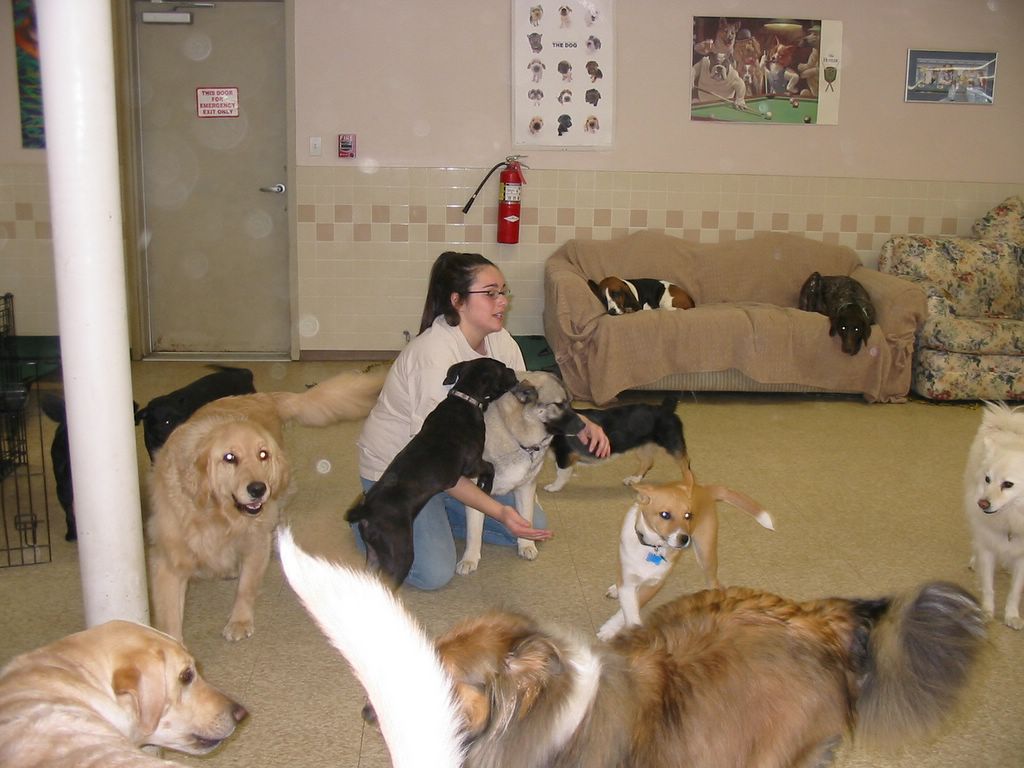
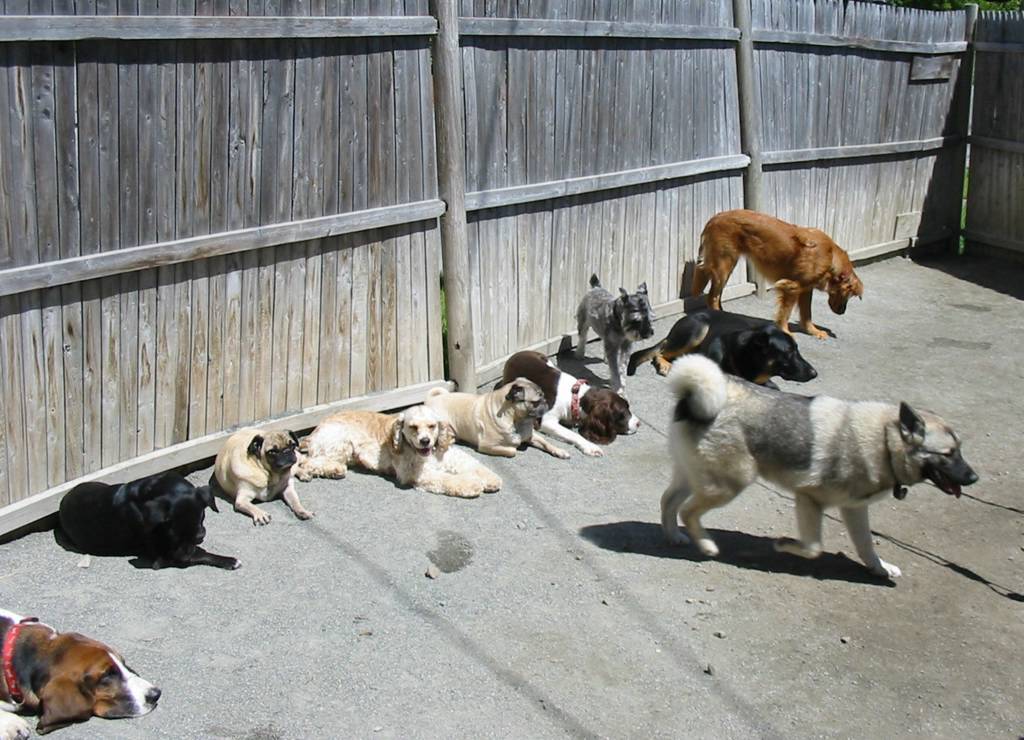
But you're exhausted when you get home at night, right? Me too!! So who wants to throw a ball for Benny (whose a ballaholic - doesn't want one throw, wants twenty). The answer is... DAYCARE!!!! Dog daycare is the best thing since sliced bread, providing that you find a place that is clean (no smells!) and has high standards around supervision, handling, and the health of each guest. The very best place if you're anywhere near central Massachusetts is The Doggie Den (www.thedoggieden.net). Our doggie guests play in large indoor areas under constant supervision all day long. We wash down both the play areas and the outdoor area where the guests do their business with a high quality animal quarters disinfectant called Cherry 256. It kills all the parasites, bacteria, and virii that make doggie daycare chancey in less fastidious places. Vets will tell you they're not crazy about daycare 'cause it spreads disease. But not us!! Local vets recommend us because we send dogs with a cough or diarrhea home. I've been trained in doggie first aid, and in the basic symptoms of the most common ailments. Our customers are grateful that we signal any problem right away and recommend a trip to the vet's office. We do not let dogs associate with others if we suspect a communicable disease.
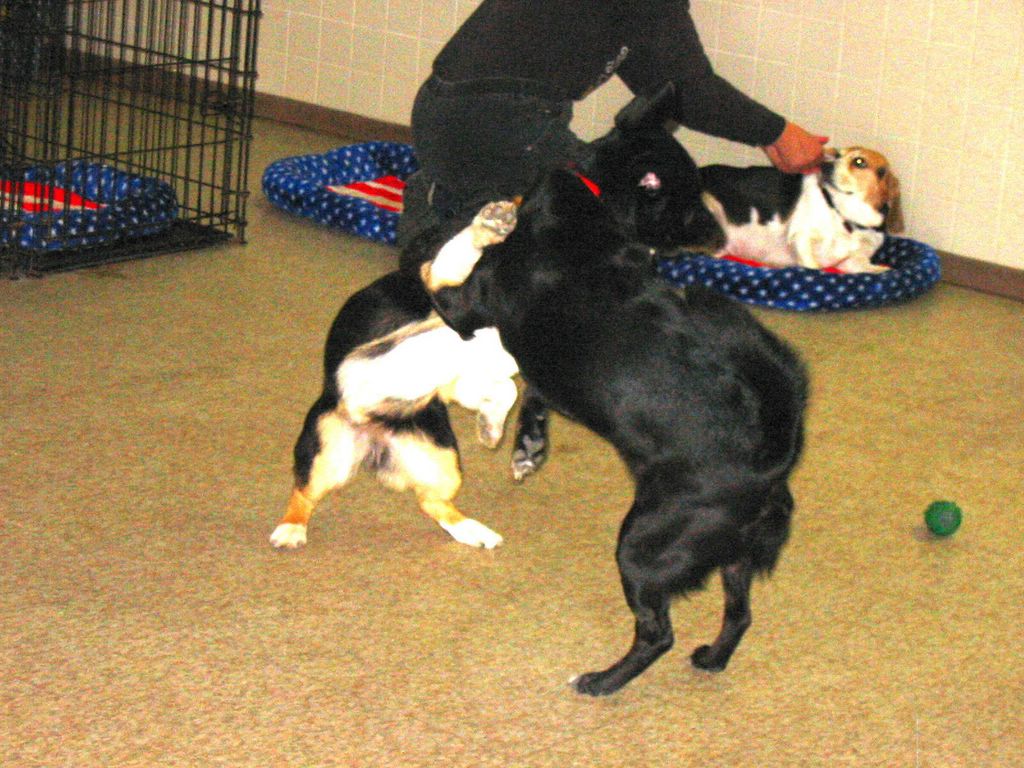
The other thing you want to know about your potential play group or day care is: how much exercise does my Baby really get? At The Doggie Den, our guests are free to play from 9am to 6pm. We open at 7am, and we crate the arrivals or leash them in place until 9am, when everyone is freed for the rest of the day. Be sure to ask if doggie guests are crated or restrained for any part of the day. At The Doggie Den we get constant 'thank you's' from customers whose dogs come home exhausted! And that's what you want. Supervised play for extended periods of time! And there should be comfy bedding available in the play areas so the pups can rest when they want to. At The Doggie Den we give everyone a treat at 1pm, then sit down and encourage them to rest. Just like kids' daycare!
It's great if you walk your dog twice a day or more, but most breeds will develop nervous habits if that's all they get. They also get fat, which leads to health problems like heart disease and arthritis. Goldens, Dobermans, Labs, Jack Russells, Shih Tzus, Lhasas, Dalmations, Scotties, Westies, Wheatons, Collies, Cockers, Bulldogs... each breed needs a different amount and kind of exercise, but don't kid yourself, they all need some!
Time after time people tell me their dog gets plenty of exercise - she can go out in the back yard anytime she wants (people with dog doors, or whose kids let the dog out). First of all, make sure she's fenced in!! Some people like invisible electric fences; I hate them with a passion. But that's for another posting. The point is PLEASE don't let your dog outside if you don't have a fenced in area for her. Even if you live in the wilds of Australia. Encounters with wildlife always go badly for somebody, and usually it's your dog. Here in New England, we live side-by-side with hungry coyotes and foxes, as soon as you get out of major metropolitan areas. Even in cities, fights with racoons (who can be very aggressive), and chasing squirrels are activities that harm pets all the time.
Even supposing your dog is safe in your yard, you really don't know what she's doing out there unless you supervise her. So, go ahead, let her out to pee if you're in a rush and there's a fenced-in area. But don't be lazy all the time! Go out with her, encourage her to do her business and praise her. Then throw a ball or a frisbee a few times, or even just play with her. That way you know she's getting the elevated heartbeat and mental stimulation she craves. A few dogs can be depended upon to play by themselves, but they're the exception. Most will come back inside as soon as they can, 'cause they're gregarious. They want to be with their pack (you and your family). Run around with her, play tug of war, whatever. Both of you, go ahead, get off that couch!
But you're exhausted when you get home at night, right? Me too!! So who wants to throw a ball for Benny (whose a ballaholic - doesn't want one throw, wants twenty). The answer is... DAYCARE!!!! Dog daycare is the best thing since sliced bread, providing that you find a place that is clean (no smells!) and has high standards around supervision, handling, and the health of each guest. The very best place if you're anywhere near central Massachusetts is The Doggie Den (www.thedoggieden.net). Our doggie guests play in large indoor areas under constant supervision all day long. We wash down both the play areas and the outdoor area where the guests do their business with a high quality animal quarters disinfectant called Cherry 256. It kills all the parasites, bacteria, and virii that make doggie daycare chancey in less fastidious places. Vets will tell you they're not crazy about daycare 'cause it spreads disease. But not us!! Local vets recommend us because we send dogs with a cough or diarrhea home. I've been trained in doggie first aid, and in the basic symptoms of the most common ailments. Our customers are grateful that we signal any problem right away and recommend a trip to the vet's office. We do not let dogs associate with others if we suspect a communicable disease.
The other thing you want to know about your potential play group or day care is: how much exercise does my Baby really get? At The Doggie Den, our guests are free to play from 9am to 6pm. We open at 7am, and we crate the arrivals or leash them in place until 9am, when everyone is freed for the rest of the day. Be sure to ask if doggie guests are crated or restrained for any part of the day. At The Doggie Den we get constant 'thank you's' from customers whose dogs come home exhausted! And that's what you want. Supervised play for extended periods of time! And there should be comfy bedding available in the play areas so the pups can rest when they want to. At The Doggie Den we give everyone a treat at 1pm, then sit down and encourage them to rest. Just like kids' daycare!
Monday, January 10, 2005
.jpg)

Subscribe to:
Posts (Atom)