Lotsa Dogs Lotsa Fun

Lotsa Dogs Lotsa Fun
The Big Dogs Wait at The Door

Friday, July 12, 2013

ASPCA: Don't Shave Your Long-Haired Dog!

Three Reasons You Shouldn’t Shave Your Pet

Thursday, July 11, 2013 - 12:00pm
Golden retriever wearing red collar
It’s hot out there! And if your Golden Retriever or long-haired kitty seems to suffer when the mercury rises, you might feel some temptation to break out your grooming tools and give your pets a full shave-down. We get where you’re coming from.
But wait! Put down those clippers! According to experts, you’ll be doing your pet a disservice. Here’s why:
  1. While you or I would hate to sport a fur coat in 100-degree weather, your pets’ fur coats are actually providing them with heat relief.
“A dog’s coat is kind of like insulation for your house,” explains Dr. Louise Murray, Senior Vice President of ASPCA Bergh Memorial Hospital. “Insulation stops your home from getting too cold in winter, but it also keeps it from overheating in summer—and your dog’s coat does the same thing.”
Dogs’ coats have several layers, and these layers are essential to your dog’s comfort in the heat. Robbing your dog of this natural cooling system can lead to discomfort and overheating. And keeping your dog cool isn’t the only reason to leave his coat intact, Dr. Murray warns.
  1. Your dog’s coat prevents your pup from getting sunburn and helps protect her from skin cancer.
To protect your pet from sunburn and skin cancer, save longer walks for evenings, and consider applying pet-specific sun block to thinly covered areas like the bridge of your dog’s nose, the tips of his ears and his belly, Dr. Murray suggests, noting that pets with thin coats, as well as those with white or light-colored coats, are especially at risk for sun damage.
  1. There are better ways to manage your pets’ coats to keep them cool: trimming and brushing.
“It’s OK to trim your long-haired dog’s long hair, such as any hair that hangs down on his legs,” Dr. Murray says. Just never attempt to clip mats off your pet’s coat with scissors, Dr. Murray adds. And if you’ve got a long-haired kitty, leave her coat intact. Instead, brush her a little more frequently during the hot summer months.
Of course, pet parents should remember to keep pets inside with plenty of water during hot days—hydration is key! For more important information on summer pet care, visit our Hot-Weather Tips. Stay cool out there!

Check out these dog links!
The Doggie Den Homepage

Saturday, July 06, 2013

Repost: Robin Bennet on Off-Leash Play - She's the Guru!

Pet Owners: Learn to Keep Your Dog Safe!

by Dog Guru Robin on July 3, 2013
No Comments
Dog Beach
Dogs that have appropriate outlets for their energy are usually happier, healthier, better socialized, and better mannered dogs.  Dog parks have become a popular way for owners to exercise their pets.  However, for some dogs, dog parks are not all fun and games.  Here are some of The Dog Gurus’ tips for owners who want to make sure their dogs don’t get hurt, seriously injured, or even killed in an off-leash dog park where there are usually no knowledgable or trained pet professionals supervising the play.
Is it right for your dog?   The average age of the dog that enjoys a good romp with a group of other dogs is 6 months to 3 years of age.  Puppies from 3-6 months can definitely benefit, but they can also be more easily traumatized if not put in the right group.  If your dog chooses to avoid other dogs, then an off-leash play setting may not be the best outlet for your dog.  Dogs that enjoy off-leash dog play usually actively seek out the attention of other dogs.  Remember, it’s not about the dog, it’s about the environment.  If your dog doesn’t enjoy off-leash dog play, that doesn’t make him a bad dog. It merely means he’s a dog that would rather participate in some other activity.
shutterstock_48397981adultpuppygreetWhat is socialization?  Many people take their dog to off-leash play sessions so they can socialize their dog.  This is a great idea, but remember that socialization is not just about exposure to any and all things in the world.  Socialization means positive interactions are created to help a dog grow, play, and learn. It should not be a random encounter with just any dog or person available.  A bad experience, especially for a puppy under 5 months of age, can have lifelong implications.
Controlling your dog.  Off-leash dog play should not be a free for all.  Dogs do best if they have been taught some basic skills.  You should be able to get your dog’s attention and call him to you even if he’s off leash playing with another dog.  This will give you a good measure of control when he begins to get too rowdy.
Dog play…the good, the bad, and the ugly.  Not all dogs play nicely.  Some dogs play well, but only with certain playmates. Just as with children, you must choose your dog’s playmates wisely.  Educate yourself to learn the difference between play styles and make the best match for your dog.  Remember to separate dogs by size and by play style.  Small dogs should never be placed with very large dogs—even if they play well together.  Small dogs can create a predatory behavior in some larger dogs, which can become deadly very quickly.
Play styles vary.  Some dogs love to chase one another; others love to wrestle and play bite; others like to play gently using their paws like kittens; still others like to body-slam one another.  Put your dog with dogs that have similar play styles.  If your dog is gentle, she will not enjoy playing with a dog who body-slams her.  Both play styles are appropriate, they just aren’t appropriate together.
shutterstock_80650576Too much arousal can lead to aggression.  Dogs need rest periods and breaks even when they are playing.  Teach your dog to come to you periodically and don’t allow the dogs to become overly rowdy in their play.  It looks like fun, but can seep into aggression very quickly.   If the dogs don’t slow themselves down occasionally during play, you need to do it for them by calling them to you and giving them a short 30-second break.  Don’t allow play to go uninterrupted for more than 2-3 minutes at a time.
Introducing dogs to each other.  Always introduce your dog one on one and go at the dog’s pace.  Allow the sniffing to occur since it is a necessarily part of the greeting ritual.  Don’t force a dog to greet another dog if either dog is showing avoidance.  When you show up at a playgroup, have the other dogs move away from the gate before you enter. If owners aren’t there to move their dogs away, just wait until the dogs get bored and go away on their own.  Then bring your dog in when things are more settled.  Watch for any signs of stiffness or nervousness.
Supervision is the key, but you have to know what you are looking for.  Happy dogs have loose, curved bodies. They play with exaggerated, repetitive, lateral movements.  Their bodies remain fluid and loose during play.  They play taking turns (one dog pins another, then they switch roles). They also take periodic breaks.  Nervous or tense dogs are still and rigid.  They play with precise movements that are quick and tight.  They don’t take turns (one dog always seems to pin the other and keep him pinned too long).  Look for common signs of stress to see if any dog is becoming overwhelmed.
shutterstock_64511206yawning lip lickingRecognizing stress signals.  Here are some common stress signals in dogs.  If your dog starts to show combinations of these at one time, he’s probably becoming overwhelmed.  Lip licking is an easy-to-recognize signal that occurs when a dog flicks his tongue in and out of his mouth.  Yawning is not usually a sign of contentment as much as it is a sign of nervousness.  Half-moon eye is when you see the whites of the dog’s eye around the outer edge of the eye.  If your dog is repeatedly clawing and/or jumping on you in a panic-stricken sort of way, he’s asking for help.  Don’t make him “just deal with things.”  You need to assess the environment to see why the dog is so frightened.
Be your dog’s advocate.  Don’t be afraid to remove your dog from a group if the play seems inappropriate.  Ask questions and ensure those supervising the dogs have experience.  Not all play is good for all dogs and it’s up to you to make sure your dog is having a good time and learning good behaviors.
Committed to keeping your own dog safe? Take the Pet Owner’s Off-Leash Play Safety Pledge. It’s free!  Help spread the word on how to keep dogs safe!


Check out these dog links!
The Doggie Den Homepage

Sunday, June 02, 2013

How to Break Up a Dog Fight

How To Break Up A Dog Fight

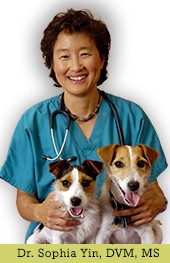
Dr. Sophia Yin, DVM, MS

Posted May 02, 2013 in Dog Behavior

Dr. Sophia Yin gives some sage advice on breaking up a tussle between dogs. For more from Dr. Yin, find her on Facebook or at drsophiayin.com!
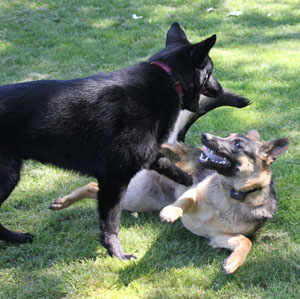
If you have a dog and he goes to the dog park, lives with doggie housemates, or otherwise socializes with other dogs, chances are that at some point you may need to break up a spat. These may range from low-level altercations with no real contact to a no-bites-spared brawl. So what should you do? First, realize that regardless of the amount of noise, most fights between unfamiliar dogs at the dog park or first fights between housemates are spit and drool matches. When bites are involved during these fights, dogs generally bite and release. So in the majority of cases we do not need to worry about prying the jaws open or getting dogs to actually release.
Instead, our major concern is just getting the dogs apart and to do so without getting bitten. The number one way to avoid being bitten is to avoid trying to grab the head or neck area. Frequently while trying to grab the front end or getting in the between the dogs, the humans accidentally get bitten. Or in the heat of the moment a dog actually turns and redirects aggression to the person pulling them away.
The safest method to get the dogs apart is to grab them by the rear end and quickly pull them away.  In other cases, because of your positioning in relation to the dog or because they are moving around too quickly, you may need to shove one away by placing your foot on their rib cage and pushing. This is safer than bending over and trying to push with your hands. It may also allow you to use your hands to grasp the other dog if you don’t have someone else to help.
Other methods for separating dogs include spraying them with water, placing a board or object between them, or banging a noisy object near them. These techniques are all meant to distract them. Other surprisingly benign distractions may work too, says Melissa Morris, a dog trainer who recounts the case of her mom’s dog.  “Her shepherd, Ruby, attacked a visiting yellow lab.  Ruby grabbed the lab's neck and wouldn't let go.  My mom was yelling at Ruby.  My brother-in-law was there and punched Ruby in the head, trying to get her to let go.  All that did is hurt his hand! My mom was holding a newspaper and lightly hit Ruby on the head with it (newspaper was not rolled up).  That distracted Ruby and she let go.”
In another situation Melissa recalls, “When my neighbor's pit bull attacked the chow that was walking by their house and wouldn't let go, they tried yelling, kicking the dog, turning the hose on him, none of that worked.  But when they opened the car door and said, ‘Let's go bye bye, he let go and jumped in the car.’

These two situations highlight that creativity may win over force. Also consider using a spray deterrent such as citronella (Direct Stop or Spray Shield) or pepper spray. They can work in some cases too. Just remember—in all cases avoid actions that will cause the dog to redirect it’s aggression to you or even unintentionally lead to a bite.
What to Do Once the Dogs Are Apart
Once you have the dogs apart you should pay attention—does your dog want to keep fighting or does he immediately calm down or try to get away? The one who wants to continue fighting will require more work to modify the behavior in the future. In either case, you’ll want to understand why a fight occurred instead of just assuming it was a fluke or hoping the same type of situation won’t occur again. A majority of the dog aggression behavior cases involving bites that I treat have a history of getting into low level spats which over time developed into more dangerous fights. Many fights can be prevented simply by noticing when one dog is tense around another and calling the two dogs apart before there’s trouble and then rewarding your dog for good behavior.
To learn how to recognize signs that your dog is anxious and may be ready to get to a fight reach Chapter 1 in this free online book: Low Stress Handling and Behavior Modification of Dogs and Cats. To learn how to teach a really good "come when called," read this blog and watch this video.
Check out these dog links!
The Doggie Den Homepage

Thursday, May 30, 2013

Cesar Millan on Nuisance Barking

This is a repost from Cesar Millan.

Three Keys to Stop the Barking

By Cesar Millan
It is completely natural for dogs to bark, and it’s one of their most important forms of communication after energy and body language. Dogs will bark as a warning, to protect their pack and territory. They will also bark to express excitement.
Those forms of barking are rarely a nuisance and don’t last long. That is why nuisance barking almost always has the same cause and the same solution. When a dog barks excessively, it’s telling you that it is bored and is looking for stimulation or a challenge.
Inevitably, excessive barking indicates there is a problem with the human, and not the dog; there is something not balanced in the pack, so the dog’s needs are not being met. The barking is the only way the dog has to tell you something is wrong.
A barking dog needs Exercise, Discipline, and then Affection, in that order. Exercise and Discipline will provide the physical and psychological stimulation that your dog craves. Affection — but only when your dog is in a calm, submissive state — will reinforce the behavior that you want without rewarding the behavior that you don’t.
I’m sure you’ve seen it countless times — somebody with a small, excited dog that won’t stop barking, who then picks up the dog to try to stop it. Unfortunately, this is exactly the wrong approach. The attention and affection from being picked up tells the dog, “I like what you’re doing right now.”
This is unintended positive reinforcement, and it only takes a few times to train a dog that its barking is something you want. But it doesn’t only happen in the above scenario. How many of you come home to be greeted by your dog’s excited jumping and spinning and barking? And how many of you immediately give affection in return for what you interpret as happiness?
This is one of the most difficult things for dog lovers to grasp. When a dog returns to its pack, they are not greeted with excited barking and jumping. Sometimes, there will be sniffs and tail wags, but most of the time it’s no big deal when a dog comes back to the pack. Unfortunately, we humans tend to make a big deal out of coming and going from home, and this puts your dog in the wrong state of mind.
If you greet your dog in an excited manner, then she will come to expect your return to be a time of excitement. This means that, while she’s waiting for you to come back, she will anticipate that excitement, and become frustrated and bored. Now, if you also make a big deal before you go, you’ve left your dog in an excited state as well. This is the perfect formula to create an excessive barking problem.
The solution is more simple than people think. It begins with providing your dog plenty of exercise via the walk, along with discipline by giving him jobs to do and commands to learn. But, most importantly, it requires that you do not reward unwanted behavior, particularly excitement, with affection.
Don’t worry. Your dog won’t think you’re mean if you aren’t petting her or giving out treats 24/7. Your dog wants to earn your affection. Allowing her to do that, and to see your happiness is, to your dog, the biggest reward of all.

Read more: http://www.cesarsway.com/dogbehavior/dogbarking/Three-Keys-to-Stop-the-Barking?utm_source=CMI_FB&utm_medium=Post&utm_campaign=5.29.13#ixzz2UmHHO0pa

Check out these dog links!
The Doggie Den Homepage

Wednesday, May 29, 2013

How Do I Know If Dog Play is Healthy?

This is a repost.  The Doggie Den thanks the author, Casey Lomonaco!

 It's Playtime! 6 Signs of Healthy Play in Dogs

How can you tell when that display of teeth means fun, not business? Here are a few training tips.
 |  Jan 16th 2013  |   34 Contributions

Last week, I shared some of the training tips I give to clients who are seeking appropriate playmates for their canine besties. This week, I'll talk about how to recognize signs of healthy play in dogs.
First-time pet owners are often in for a small shock the first time they see their dog actually play in the classroom. "OMG! He is growling, and that dog just bit his neck! That other dog over there is HUMPING another dog! Wait, my dog just bit the other dog in the neck, too! This is too aggressive. I'm uncomfortable."

Dog play can look like fighting to the first-time owner. Best friends play by Shutterstock
Let me get one thing straight: Dogs don't "do" Legos, video games, or Barbies. They jump, chase, bite, growl, bark, and wrestle. Many of the things that happen in play may look like aggression, and it is true that play can escalate into aggression rather quickly if left unchecked.
So how can you tell when that display of shiny teeth means fun instead of business? Here are a few signs of healthy play to look for.

1. Reciprocity and role reversal

"I scratch your back, you scratch mine" is the mantra. I like to see frequent role reversal in play with friendly dogs -- I chase you, you chase me. I tackle you, you tackle me. I bite your neck, you bite my neck.
If I consistently see one dog tackling another and the other dog is not offered the opportunity to tackle back, it is often more bullying than play, and the owner of the dog who is tapping out on the ground needs to step in.

Tag is a great game, as long as the dogs take turns being chased. Dogs play in water by Shutterstock
When it comes to chasers, you have some dogs that only like chasing and do not like being chased. This can be a problem for the playmate, who says, "Hey, I want to chase, too!" If the chase-ee is always trying to get away from the chaser, you should definitely intervene.

2. Take frequent breathers

I also like to see frequent, self-imposed breaks. "Breathers" are just that -- seconds-long pauses where each dog gathers her wits before re-engaging in play. Breathers don't have to last very long, and then the dogs will reinitiate with one another.
If dogs do not give these frequent self-imposed breaks to one another, it is a good idea to step in and make them do so before releasing them back to play; just ask for a few simple behaviors and then release your dog to join the fun. I find that humans often have to do this when two friendly dogs first meet, but that the dogs quickly learn to regulate themselves after minimal intervention.

3. Happy dogs have Jell-O bones

"Jell-O-y" is my uber-scientific technical term for the body language of happy dogs. When dogs enter the dog park with stiff tails and stiff bodies, they are asking for trouble. If one dog looks like he has a vibrating coat hanger stretched straight up through his tail, the "play" interaction will likely not be very enjoyable for anyone.
There is a looseness in the body language of happily engaged dogs: Tails are swishy, tongues are lolling, bodies are wiggly, eyes are sparkling.  Much as play is a topic worthy of its own book, so is canine body language.  My friend Carol Byrnes, owner of Diamonds in the Ruff training center in Spokane, has two great CD-Roms on canine body language, What Is my Dog Saying? and What Is My Dog Saying at the Dog Park?  The latter is a must-review if you want to learn more about the mechanisms of dog body language as it relates to canine social interactions.

Loose canine body language means the play is fun, not serious. Dog friends play ball by Shutterstock

4. Make sure your dog gets plenty of exercise

Every time I see a dog enter the dog park on a tight leash, eyes bulging, panting and out of control like he hasn't had adequate exercise in ages, I cringe. If your dog comes in like a freight train, it's not exactly safe for the other dogs who may be near the tracks!

5. Go with the flow

Dogs who are playing well are essentially going with the flow. You will want to see nearly constant, nearly fluid movement. Watch for changes or disruption in the flow -- maybe a higher- or lower-pitched vocalization than during the previous play.

Is this game about to turn serious?
Similarly, there is a difference between a "breather" (where dogs typically have very soft eyes and open mouths, tongues lolling out) and a visual lock-on, where the dogs stop playing and one or both will get stiff and stare. This is a signal for you to step in and quickly diffuse tension by creating space for the dogs. If the "chase-ee" has previously been running with a happy, loose tail, but you see it go between her legs and tucked firmly against her belly, step in and help her before things go wrong.

6. Smart owners make happy dogs

By far the best sign that play will go appropriately is when you carefully select your dog's playmates, teach yourself about play and body language, and know your dog well. Some dogs, as they get tired, become cranky and have less patience in play. Others take progressively more and longer breaks until they are sleeping.

Happy dogs are those who are well-matched playmates. Schnauzers with Frisbee by Shutterstock
Know your dog, know the dogs your dog is interacting with, and have a plan in place. What are potential conflict triggers for your dog? Do you have an intervention strategy planned, and if so, at what stage will you implement it?
For more tips on how to ensure you and your dog get the most enjoyment possible from your playdates, check out my article "Dog Park Etiquette: Do's and Don'ts from a Trainer." 

How does your dog play healthily at the park? At home? Let us know in the discussion below!

Check out these dog links!
The Doggie Den Homepage

Sunday, May 26, 2013

The Best Way to Brush Your Dog's Teeth

This is a repost from Dr. Jon's Newsletter:
http://www/petplace.com

Oral hygiene is essential to your dog's overall health.  Oral disease is very common in pets. In fact, the American Veterinary Dental Society reports that by the age of three, oral disease is present in up to 80 percent of dogs.  You can significantly reduce your dog's risk of getting oral disease by establishing a healthy oral-care routine early in your pet's life.

According to the American Veterinary Medical Association (AVMA), a dog's teeth should be brushed daily; however, because many dogs initially resist daily brushing, most people don't do it that often (if at all). But experts say some form of regular brushing is better than no dental care at all. Brushing at least every other day is enough to prevent the buildup of tartar on your dog's teeth.

Taking care of your dog's teeth doesn't just prevent bad breath. Poor oral hygiene can start a domino effect of health problems for your dog.  Built up bacteria becomes plaque, which eventually becomes tarter.  Periodontal disease is a direct result of bacteria that lives in tartar.  It can lead to a variety of problems including tooth loss, pain, gum disease and bad breath.  It can also contribute to liver, heart and kidney disease.

Protecting your pet from the pain and health risks that come from poor dental hygiene is very simple, and it saves you the time and expense of additional vet visits.  The best way to do this is to brush your dog's teeth regularly.  I understand this isn't always easy and it may take your dog some time to get used to this routine.  To make it easier I recommend introducing the toothpaste and toothbrush slowly and rewarding your dog for any progress he makes.

When brushing your dog's teeth, it's very important not to use human toothpaste.  It can make your dog sick and even poison him.  You want to be sure to use a pet-friendly toothpaste and a toothbrush that's sized to fit your dog's mouth.

If you're ready to get your dog into this healthy habit, check out Pet Product Advisor's Kissable Toothpaste & Toothbrush Combo. I've seen how much time and stress these products can save.  The vanilla-flavored toothpaste is delicious enough that dogs actually enjoy the taste.  The three-sided toothbrush is just the right shape for a dog's mouth because it targets the outer, top and inner parts of the teeth at the same time.  That means you can brush your dog's entire mouth in less than a minute.


This powerful combo works together to remove food and bacteria from all angles of your dog's teeth, so you can rest assured his mouth will stay clean, healthy and fresh. Check it out: www.petproductadvisor.com/doggietoothbrush

Check out these dog links!
The Doggie Den Homepage

Monday, April 22, 2013

How Smart is Your Dog?

This is a repost from Dr. Jon:

Dogs are very smart animals.  In fact, some scientists estimate that the average dog is as smart as a 3-year-old child.  That means he is smart enough to understand more than 150 words, smart enough to count to five - and smart enough to outsmart the humans! (No doubt you've already learned that lesson.)

Yes, dogs are very smart - and some breeds are thought to be smarter than others.

Psychologist Stanley Coren, a leading canine researcher and author from the University of British Columbia, studied which breeds are the smartest. He analyzed data from 208 dog obedience judges in the USA and Canada to see where each breed fell on average.  Check out the results below to see if your dog made that list:

1. Border collies
2. Poodles
3. German shepherds
4. Golden retrievers
5. Dobermans
6. Shetland sheepdogs
7. Labrador retrievers

(Of course, we can't forget that these are just averages - every individual dog is different. We've met some really intelligent “dumb” breeds, and some very silly “smart” ones!)


Check out these dog links!
The Doggie Den Homepage
Sunday, March 24, 2013

Dr. Jon on Leaving Your Dog Alone (Repost)

Do you feel bad when you have to leave your dog home alone?  Many people do.  It's only natural. But life goes on and sometimes we don't have choice.

It's a busy world.  And like most of us, you've got places to go, things to do and people to see.  Whether you're off to work, school or shopping, or out for a nice dinner and a movie, chances are you spend a lot of time away from home.  And sadly much of the time, your dog cannot come along.

Dogs have very little to occupy their time while you're gone, especially if they're the only pet in he household. (We're their entertainment.)   Some dogs seem content to nap away their day while you're away.  Other dogs have a much harder time coping with the situation when they're home all alone.  These dogs can suffer from boredom, stress or separation anxiety.

So how do you know if your dog is unhappy about being left alone?

Some dogs make it quite obvious by leaving a trail of destruction behind.  You could return home to find your furniture or personal belongings chewed up, the garbage ransacked, paper or pillows chewed to shreds, or you may find that your dog has vomited, urinated or defecated in the house.  Some dogs eat everything in sight when you're away, and others become almost anorexic.  Some dogs groom themselves incessantly to calm their nerves.  Others vocalize their dissatisfaction by howling, whining and barking while you're away.  (And if you have neighbors nearby, you're sure to hear about it!)

If your dog is bored, anxious, depressed or destructive while you're away, "environmental enrichment" can help.  When you give your dog plenty of fun things to do and see, his unhappy time alone can be transformed into a very satisfying day.  Here are some suggestions:

• Hire a dog walker
• Invest in doggy day care
• Leave plenty of fun toys for your dog (like puzzle toys that you fill with treats)
• Tire him out with some active play before you go
• Try something that will really hold his interest, like the Dog Sitter DVD.

If you haven't seen the Dog Sitter DVD yet, you really must check it out.  It is amazing!  This DVD was made especially for dogs, to entertain them for hours on end while you're away.  It features lots of animals (birds, cats, squirrels, raccoons and more) outdoors in their natural environment.  Your dog will think he's outside with his new friends joining in the fun.

Dogs just love this DVD.  It really holds their interest and the stereo soundtrack even has some sounds that only your dog can hear.  And once you find out which tracks are your dog's favorites, you can even personalize his viewing adventure using the continuous loop scene selection feature.

When your dog is stuck inside all alone, the Dog Sitter DVD can bring the outside world in.  Lots of people swear by it, and I can certainly see why.  My staff and I tried it on our own dogs and they were GLUED to the TV set!

Until next time,

Dr. Jon

Check out these dog links!
The Doggie Den Homepage
Monday, February 04, 2013

Dr. Jon on Leaving Your Dog Alone

Below are Dr. Jon's suggestions for alleviating separation anxiety.  He publishes on petplace.com. https://bay002.mail.live.com/default.aspx?id=64855#n=880813660&fid=1&mid=d0b00541-6ecb-11e2-a191-00215ad80204&fv=1

But at The Doggie Den we have an even better idea: ENROLL YOUR DOG IN DOGGY DAYCARE!  The Doggie Den

I've heard of lots of creative ways to ease your pets' stress, like leaving the TV or radio on for "company" when they are home alone. Unfortunately, that could actually be doing more harm than good. Studies have suggested that TV and radio can actually CREATE stress for our pets because of the drastic changes in programming and the random mix of musical styles.
Think about it - how scared would you be if you suddenly heard gunshots, sirens, or dogs barking?
The TV and radio certainly create "noise," but they don't necessarily create a relaxed environment.

Dog owners sometime ask me, “Does music soothe pets the same way it can relax people?" The answer is "yes" - but it depends on the music.

Studies have been done to examine the relationship between music and stress, and some of the results might surprise you. All music is not the same…and neither is the effect on animals. Classical harp music is used around the world to help alleviate stress in dogs, cats, chimpanzees and other animals. Even animal shelters are installing sound systems and using music to create a more serene environment.
In particular, studies show that dogs and cats seem to show lower levels of stress when exposed to classical music. Cats will relax in front of the speakers when classical music is playing, and many dogs will actually bark less - especially when listening to the music of Bach.

That's why I want to tell you about the Music My Pet CD.

This remarkable "Classic Cuts" CD was developed for the specific purpose of calming our pets. It uses the sounds that have been proven to calm dogs, cats and other household pets. Music My Pet was created by the same folks that brought you Disney's award-winning Baby Einstein series for kids, so this is music for pets at its very best.

Check out these dog links!
The Doggie Den Homepage

Friday, January 25, 2013

Brrrr - It's Cold Outside and Your Dog Feels It Too!

Here's what Dr. Jon has to say about keeping your dog safe and happy in the dead of winter:

The reality is that, for most of my US readers winter is here and it is not leaving anytime soon. 
So what can you do if you are stuck indoors with your dog?
Well, believe it or not this can be a GREAT opportunity to have fun with your dog and pamper them at the same time. Today I'd like to share some of my favorite suggestions to make this cold, dreary season into one that you both look forward to. Take a look:
  1. Help your dog relax with a soft, warm new bed. Shopping for a bed? Here are some tips on what to look for in a bed before you shop. This is interesting because there are really important features that I hadn't thought of. Go to How to Choose a Good Dog Bed.
  2. Soak up the sun by opening the shades or curtains and giving your dog a nice place to nap.
  3. Don't keep them outside too long. It is extremely cold in many areas of the country. Frigid temperatures pose a real risk to dogs, especially when frostbite becomes a possibility or if they get wet. Keep them dry and limit outside time during temperature extremes. Be especially careful on windy days as wind chill can greatly increase the risk of injury. For more information go to: How Does the Wind Chill Affect Pets. You'll be surprised about what you'll learn in this article.
  4. Keep things active. Dogs want and need exercise all year round. Physical activity is good for the muscles, allows your dog to expel excess energy, keeps him mentally stimulated and helps prevent boredom.  When he does come in, dry his paws with a soft cloth. This will keep your home clean and get rid of snow, ice and salt that may otherwise get tracked in. 
  5. Have fun! Just because it is winter doesn't mean you can't still play games. Here are some very cute ideas. Go to: Beyond Snowballs - Winter Games to Play with Your Dog. 
  6. Be safe, not lazy. When it is cold, many pet owners are tempted to let their dogs "out" on their own. Bundle up and take him out on a leash as usual. Allowing your dog to go out unsupervised is a common way for dogs to end up lost or injured. It is really common for dogs to be let out and get hit by a car when it is cold (and their owners don't want to take them out).
  7. Make sure your home is safe. Keep objects your pet may chew and ingest out of their reach. Keep toxins (such as anti-freeze) safely put away. Prevent exposure to all human medications.  
Lastly, take time to spend with your dog. Brush him, comb him, curl up with a book or watch a movie with him. Remember, you are your dog's best friend.  

Until next time,
Dr. Jon


Check out these dog links!
The Doggie Den Homepage

Wednesday, January 23, 2013

Dr. Jon on Your Dog's Dry Winter Skin

Ever had a bad hair day? How about a bad hair season?

Believe it or not, some dogs experience discomfort and frustration every winter because of their fur and skin. The cold, dry air of winter can give your dog flaky, rough, painful skin. This in turn can lead to everything from a dull coat to scratching and even hot spots or skin lesions.

Your dog doesn't have to summer just because of the weather. Stop winter in its tracks by taking some time to prepare your dog for the season. Today I'd like to share some tips that can help alleviate these symptoms.

First things first, remember that a major factor in irritated skin is dry winter air. As soon as temperatures start dropping, a humidifier can help prevent symptoms. (As a bonus, this can also help protect the humans in the household from similar problems.

But what about times like now, when it's already in the middle of winter? Is it too late to help? Don't worry, your dog isn't doomed to suffer for the next several months. You can help him right now too! Keep these things in mind if your dog has dry, itchy skin:

Rule out health problems: Even though flaky skin and a dry coat are common during winter, they can also indicate a more serious health problem. If you notice these symptoms, the first step should be to have your vet rule out any medical issue.

Bundle up for walks: Some dog owners dress up their dogs for fun, but during the winter months your pooch will actually benefit from wearing a coat during walks. This will not only keep him warm, it will also protect him from the effects of the dry frigid air. This is especially important during windy days when wind chill significantly increases the risk of frostbite.
Groom regularly: How frequently do you brush your dog? If your answer is “not often,” it's a good idea to start grooming your dog more. Brushing your dog's fur stimulates the production of the very oils that keep your dog's skin moisturized. It also evenly distributes those oils throughout his coat, leaving it shiny and healthy. Be careful though; more grooming does not mean more bathing! Frequent baths wash away the same healthy oils that help your dog's skin stay healthy, so don't bathe your dog more than once a week unless recommended by your vet.
Rethink their diet: One of the most common causes for dry skin is something most people don't consider: their dog's diet. Poor nutrition can lead to a dull coat and dry skin. You might think your dog is eating right, but poor skin is one very big sign that their diet needs an update. Make sure that your dog is getting a diet rich in proteins, fatty acids, and other nutritional needs. Consider switching to an all-natural dog food that will provide your dog with all that they need to be healthy.
 Reprinted from Dr. Jon's Dog Crazy Newsletter
Check out these dog links!
The Doggie Den Homepage

Thursday, November 29, 2012

Here Come the Holidays!


Hanukkah and Christmas
So it's the holidays. Christmas cookies, potato latkes, fruit cakes, punch bowls, chocolate Santas and Hanukkah gelt: whatever your tradition, it surely involves rich treats. So this is also the time of the year to remind ourselves that holiday treats are dangerous for dogs.

This is true almost without exception. Chocolate is downright toxic and can kill your dog, if she consumes a lot of it.  Other holiday specialties will make her ill in varying degrees.  Alcohol is a disaster.  It's not funny to watch your dog lap up spiked eggnog.  Really, it isn't. It could make her suffer, and could transform your holiday into a vigil at an animal hospital.

Similarly, dogs can’t digest oily latkes, or shortening-rich fruitcake. Mostly, what goes in comes out, the latter inevitably in the middle of the night, after you’ve stayed up partying and are exhausted. So make, and keep, a rule that the dog only gets treats that are meant for her. Festive holiday dog treats are available at pet stores everywhere. Take advantage, and make sure your family understands whose treats are whose!
                     
Here are 5 tips to help avoid an emergency vet visit and enjoy your Hanukkah:
 
1.  Sufganiyot – Otherwise known as doughnuts, they are filled with artificial sugars, jelly, fat, and empty calories. They’re a delicious treat for us, but can cause vomiting, diarrhea, and decreased appetites for
dogs. Be very careful to not let your canine buddy get any of these doughnuts and make sure he can’t counter surf and lick up ingredients that are lying about.

2.  Latkes – They are savory and they taste amazing, but they have onion in them. Onions can cause anemia in dogs.  Also, the oil, sour cream, and other ingredients are bound to upset your dog’s stomach.

3.  Chocolate coins – This is a traditional candy that children receive, and they’re wrapped in shiny gold and silver foil. The foil, chocolate, and netting that they come in can be dangerous to your dog’s entire GI tract. Chocolate contains caffeine and theobromine, which dogs cannot digest, and in extreme cases they can be fatal. If your dog swallows the foil and net bag, induce vomiting immediately.  A teaspoonful of diluted hydrogen peroxide in an eye dropper will do the trick.

4.  Dreidels – They’re great toys for kids and but you don’t want your dog in the game.   She’ll want to join in the fun and try to pick the dreidel up in her mouth. If your dog swallows a dreidel, or any small object, induce vomiting and call the vet. Keep all game pieces out of your dog’s reach.
 
5
: The Menorah – This is an essential symbol for Hanukkah, but the candles that you light each night pose a danger if your dog likes to jump up, leap over things, or generally race around the house. The menorah could fall over or singe her nose or fur.  Keep the menorah up high and out of pup’s reach. Make sure it’s on a stand or other stable surface so if your dog comes galloping into the room, she doesn’t shake it loose and start a fire.

And here are some tips to make Christmas fun for your family and the dog:
First, be aware of holiday hazards, and supervise your dog when he's exposed to them. For example tinsel, Christmas lights, wires, glass ornaments, poinsettias, mistletoe, and other holiday decorations can be deadly if chewed.  Don't leave pup alone with any hazardous materials, not even for a minute!  You don’t want Christmas to be interrupted by an emergency visit to a veterinary hospital.

To help pup share in the fun, place dog-safe toys and ornaments on the bottom branches of your tree, and let him play with them.   You can find them at any pet store.  Attach them with string, not wire. And beware of chewing on evergreen branches or pine needles.

Of course, he’ll make every effort to convince you to share your Christmas pudding, don’t give in!  Dogs' digestive systems are quite different from ours.  Their intestines are much shorter, and they digest very quickly, a trait left over from the wild where it was necessary to get protein into the system quickly. They absolutely cannot process ingredients that we take for granted, such as nuts, holiday spices, and hydrogenated fat.  So, if you don't want to get up at 4 am on a cold winter’s night, limit your pup to treats that are intended for him.
So, what about dress up? By all means! Hats, suits, collars, boots, it's all good. Just remember that dogs in costumes should be supervised at all times.  Left alone, they may treat their adorable dreidel coat or reindeer antlers as toys, which means “chew baby, chew!” And dog accessories are definitely not safe for eating.

So have a fun, happy holiday season - and help your pup to have one too!


Holiday puppies: a big no-no!

By November, your local puppy store is in high gear. They’re out to convince you that puppies make the perfect holiday gift. What could be cuter than a new puppy on Christmas morning?  Or a cuddly new family member the first night you light the menorah?

Actually, it would be hard to make a worse choice! Reputable breeders are loath to sell in December, because they know that by February the puppy is likely to find himself abandoned in a dog shelter or, if he's lucky, returned to the breeder.
The holidays are a busy, stressful time and people are exhausted.  It's a time when we struggle to meet our regular commitments, along with preparing for the holidays.  It's certainly not a time to take on the work of a new puppy. 
A couple weeks into January, the kids will be back in school, mom and dad will be rushing off to work every morning. The weather will make you want to hibernate.   Just when everyone could use a break, that adorable puppy will be soiling the carpets, chewing on furniture, stealing food, throwing up in baskets of clean laundry, and  generally acting out of control.

If your family is ready for a dog, wait until February or March when things have calmed down, and warmer weather is on the way.  Cold weather makes house training difficult, if not impossible; and the spirit of the season prevents you from making a realistic decision about a new dog. In the spring your family will spend more time outside, and feel a greater inclination to train the new family member.


Check out these dog links!
The Doggie Den Homepage

Friday, November 16, 2012

Repost from Live in Nanny on Kids with Dogs

10 Ways to Teach Young Children to Be Nice to Pets

When kids learn to treat animals with gentleness and respect, they also learn about compassion and caring on a larger scale, which are traits that can later be applied to the relationships that they have with fellow humans. For parents of toddlers and young children, imparting these lessons can be a bit of a challenge; here are 10 ways to help your little one understand the importance of treating animals well.
  1. Set a Good Example – Children learn primarily through mimicry. They watch their parents and other authority figures, and then model their own behavior after their observances; one of the best ways to instill a love of animals is to have that same love yourself and to exhibit it often.
  2. Research Local Programs – Your local Humane Society chapter or other animal activism organization is likely to have a program or two specifically directed at helping small children understand the proper treatment of animals. A cursory glance at a local message board or search engine results could net dozens of options.
  3. Take Advantage of Story Time – Most kids love a bedtime story, and there are tons of books on the market written with this very subject in mind. A colorfully illustrated, well-written book about animals and the humans that love them can do wonders for explaining the concept of animal kindness to kids.
  4. Teach Proper Handling of Small Animals – Helping a child to properly hold and handle a small or newborn animal while emphasizing the importance of being gentle is a great way to teach a hands-on lesson about carefully handling animals and never being too rough.
  5. Visit a Petting Zoo – Spending an afternoon at the petting zoo can be a fun and informative experience for kids of all ages, but especially for little ones who wouldn’t ordinarily have the opportunity to interact with such an interesting array of animals or have access to professionals that are trained to help kids learn about them.
  6. Share Interesting Facts – Learning that baby goats are also called “kids” or that butterflies taste with their feet not only entertain children, but also help them to see that animals have their own unique, interesting qualities.
  7. Help at a Shelter – Taking a trip to your local animal shelter to help walk the dogs, feed the cats or do other fun and interactive chores not only makes a difference in your community, but also in your child. It might be best to stick to a privately run no-kill shelter or to be sure that no animals are scheduled to be euthanized during your visit, however, to avoid a traumatic experience.
  8. Study Local Wildlife – A trip to a local nature preserve or national park not only provides kids with a day of no-television fun, but can also help them understand the very important concept that wild animals are not pets, but should be treated with the same respect.
  9. Watch Kid-Friendly Television Programming – While you might want to skip the program chronicling the antelopes’ encounter with a hungry lion, there are plenty of kid-centric animal documentary shows that can provide strong talking points and valuable information.
  10. Get a Pet – After you’re certain that your child understands the basic treatment of animals, introducing a pet into your home is a great way to keep their education going. Even if you live in a small space or urban environment that isn’t conducive to traditional pets, a small hamster or a goldfish can still help give your child a sense of responsibility.
Most small children need to be reminded to be gentle more than anything else, as deliberate cruelty is quite rare in children so young. Kids that show signs of harmful behavior might be struggling with a larger issue. If this is the case the child’s pediatrician should be consulted.

Check out these dog links!
The Doggie Den Homepage