Lotsa Dogs Lotsa Fun

Lotsa Dogs Lotsa Fun
The Big Dogs Wait at The Door

Thursday, January 19, 2006

The Dog Days of January

Hello Dog Lovers!

Happy New Year and best wishes for 2006! Health, play buddies, and goodies for the dogs.

It's been a while since my last post. We've been busy beavers... oops! pups since the holidays. We're beefing up our obedience training offerings and getting a speaker/special event schedule going for 2006. But I can't let any more time go by without talking about what mid-winter is like for our canine companions. To cut to the chase, it's not a great time. Some breeds like the snow, especially when it's fresh (like labs and goldens) but many have problems. And even the snow lovers bear watching in freezing temps.

In doggie daycare we notice that both small and large dogs pee and poop indoors more than in mild weather. Often we'll take everybody out to the yard for a while, then several guests will squat as soon as they come back in. One of the problems is that they get interested in playing in the snow and forget to do their business. Not much to do about that except to discourage the playing and praise them generously when they do perform. Another problem is that muscles tend to contract in the cold so the urethera and bowels kind of go on "hold".... as it were. Then in the nice warm indoors, they relax, and voila! We try to break up play as soon as it starts until the dogs perform - that is before they tense up with the cold. Also we give treats for outdoor performance when it's below freezing. The praise and treats tend to get the non-performers imitating the others.

During the mid-winter months, our groomers tend to see undiagnosed frostbite and/or dry, cracked toe pads. No matter the breed, dogs should not be outdoors for more than a few minutes in 20 degree weather, unless of course they wear Mukluks or other dog boots. You'll notice that Alaskan sled dogs are always booted - it cuts down on wear and tear and prevents frostbite during long mushes. Even if you're careful, though, your pup's pads are likely to dry out, partly from dry air and partly from the salt on sidewalks, streets, and parking lots. Fastidious owners who have time, clean their dog's feet after exposure to salt, but most of us probably don't. The best remedy is fast and cheap. Rub a good lubricant into pup-pup's pads - all 20 of them! We use vaseline and it works great. I rub it into Benny and Daphne's pads once a week when we're watching TV and they never have a problem in spite of extensive exposure to salt (and I'm not a fastidious mom, either).

Also, make sure to give your pup plenty of water, particularly after they've been outside. Cold dry air dehydrates them, and sometimes they need water even if they don't feel thirsty. I urge Benny and Daphne to drink fresh, just-poured water after we've been outside, and they usually bite - ur slurp, I mean. Once they taste the water, they realize they're thirsty.

Monday, December 19, 2005


Pup-Pup enjoys her holiday gift Posted by Picasa

Safe holidays for the Dogs

Here are some tips about how to make the holidays safe and fun for the family dog, as well as for yourself. First, be aware of holiday hazards and supervise your dog when she's exposed to them. For example tinsel, Christmas lights, wires, glass ornaments and holiday decorations can be deadly to pets. Don't leave Pup-Pup alone with any hazardous materials, not even for a minute! Make sure your holidays aren't interrupted by an emergency visit to a veterinary hospital.

To help Pup-Pup share in the fun, place dog-safe toys and ornaments on the bottom branches of your tree, and let her play with them. Attach them with string, not wire hangers. And beware of chewing on evergreen branches or pine needles, for they can make her quite sick.

Of course, she'll make every effort to convince you to share your Christmas pudding. Don't give in! Cakes, pies, puddings, and especially candies contain ingredients that dogs can't digest (rich, processed fats, sugars and dairy products). At best, such ingredients cause diarrhea; at worst, they can be toxic (for example chocolate is a big "no-no"). Does Pup-Pup deserve her share or holiday treats? YOU BET! For yummy holiday treats fit for Fido, check out The Dogfather Bakery on Main Street in Westbor (next to the Bagel Bistro); Pets Gone Healthy on route 20 on the Marlboro/Northboro line; and Pet Source, in the RK Mall in Marlboro, next to Hannaford's Supermarket.

The Doggie Den Homepage

Friday, December 16, 2005

Holiday puppies a No! No!

By now, your local puppy store is in high holiday gear. They want to convince you that puppies make the perfect holiday gift. What could be cuter than a new puppy on Christmas morning?

Actually, it would be hard to make a worse choice!! Reputable breeders are loath to sell in December, because thy know that by February the puppy is likely to find himself relinquished to a dog shelter or, if he's lucky, returned to the breeder. The holidays are a busy, stressful time. If you're like me, you're already exhausted. It's a time when we struggle to meet our on-going commitments, along with preparing for the holidays. It's certainly not a time to take on the work of a new puppy!

A couple of weeks into January, the kids will be back in school and mom and dad will be rushing off to work every morning. The weather will make you want to hibernate. Just when everyone could use a break, adorable puppy will be soiling the carpets, chewing on furniture, stealing food, throwing up on clean clothes, and acting generally out of control.

If your family is ready for a dog, Please! wait until February or March when things will have calmed down, and Spring is on the way. Winter weather makes house training difficult, if not impossible; and the spirit of the season prevents you from making a realistic decision about a new dog. In the Spring your family will have more time outside, and a greater inclination to train the new family member. If you don't train him, he will quickly metamorphose from cute puppy to black sheep!!

The Doggie Den Homepage

Saturday, November 12, 2005


Morgan gets lots of lovin' from the daycare crew Posted by Picasa

Sue Sternberg

This week I spent a couple of days with Sue Sternberg learning how to evaluate dogs for aggression. The seminar was intended largely for shelter workers; it focused on determining whether a shelter dog is adoptable. But even for a doggie daycare owner, the it was excellent!!

Sue has been evaluating dogs for years and her method has been studied and determined to be statistically predictive of aggression. That's impressive enough. But what really struck me was her commitment to open-minded education and dialog. She euthanizes unadoptable dogs at her shelter and I had always been against that. After listening to her experiences and the litany of misery that dogs endure in long-term kenneling situations, I'm now open to the euthanasia solution. She's a person with a big heart - it shows when she teaches; that's what convinced me that if there were another solution besides euthanizing unadoptable dogs, she would have found it.

Her method ranks dogs as (1) okay for the average family (2) in need of a firm hand with people who have clear desires and limits in terms of how they'll live with a dog, and (3) dogs that need to live with a dog professional. Before she taught us the procedure for evaluating a dog, she took us through a whole day of learning how to observe details in the dog's behavior, then collect a set of observations to make the judgment. For example, a stiff posture and upright tail don't mean anything clear all by themselves. But if the dog gives those cues, plus a hard stare, and a lack of interest in socializing with the handler, then then the dog could very well be a biter. I was impressed with the "gather a set of data" approach. It seemed much more scientific then approaches that assign meaning to specific behaviors. It allows for differences among individuals.

If you're a dog professional of any kind go to a Sue Sternberg seminar!
The Doggie Den Homepage

Thursday, October 27, 2005

Just Say No to Halloween Candy

Trick or treat, and here come the kids with satchels full of candy. Zillions of mini-portions: Snickers, Charleston chews, Almond Joy, Milky Way, Milk Duds, Smores, Twix, Hersheys, and on and on. It's the beginning of the most fattening time of year, and I'm as much of a junky as anyone else.

It's also time to JUST SAY NO to your dog, who's drooling over the Halloween booty. Not because dogs should eat better and exercise, but because excessive sugar, fat and chocolate can make him very sick! Veterinarians' journals are replete with cases of dogs that need hospitalization after finding Junior's Halloween stash. Dog's digestive systems can't handle all that fat and sugar, and chocolate can be fatal if a dog eats too much of it. At the very least, you will get the same behavioral problems that your daugter's poor school teacher has to deal with after Halloween: hyper activity, inability to focus, crankiness, and generally unruly conduct.

So PLEASE, keep the candy away from the dog, and tell your kids that it can make El Poocho very sick. Keep aromatic, upscale dog treats on hand so pup can have a taste treat along with the kids. For home-baked dog treats, check out www.dogfatherbakery.com, or www.boneappetit.com. Help the pups have a safe Halloween!!

The Doggie Den Homepage

Wednesday, September 21, 2005

Back to School Blues

The days grow shorter and the nights are cooler; September is a time of change for both dogs and their owners. With the kids back at school, our canine companions have to readjust. For many dogs, fall means "home alone", which brings boredom, anxiety and loneliness. Even when the kids are home, they don't have as much free time as they did during the leisurely summer days.

To help your dog through the transition, make sure his favorite toys are available when he's alone. To counteract his boredom, provide toys he's allowed to chew like kongs, dentabones and greenies. The benefit of a treat given as you leave the house lasts only as long as the treat itself. Put treats, peanut butter, or cottage cheese inside a kong toy so he'll have to work at getting the goodies. Set up a schedule that fits your lifestyle and stay with it so he'll begin to see that life is predictable again. Take him outside or walk him at the same time each day. Set aside certain times when his family "pack" can play with him. For example, ask the kids to play with him for a while every day after school and make sure he gets to be with you on weekends.

Most of all, cut your pup some slack. Dogs are pack animals; prolonged isolation can be painful. Consider enrolling him in The Doggie Den's playcare program at least a couple of days a week so he can play with his buddies and relieve the boredom.

If you don't help your pup through these first weeks of school, he may show difficult or destructive behaviors like jumping all over everyone who comes into the house, chewing on furniture or having accidents in the house. These behaviors aren't to "get back at you". Dogs don't think like that! They're just signs that he's anxious because things are changing.

The Doggie Den Homepage

Tuesday, August 16, 2005

Thursday, August 11, 2005

Hot hot dogs!

It's about 110 in the shade today - warm, even for August in New England. I can't resist reminding people to keep their dogs cool! Dogs have no way to cool down except if you wet their coats to the skin, because their only heat valves are panting and sweat glands in their feet.

Speaking of feet, I see so many people walking their dogs on asphalt in the middle of the day. Please don't do that!!! Sometimes dogs won't even tell their owners when their feet are burning - in fact we get cases of burnt pads in day care on a regular basis. The dog will start to limp slightly while playing and it's because his pads are sore. So find grass, dirt, even concrete to walk your dog, but not asphalt. As a test, put your palm flat against the roadway or sidewalk. If it's uncomfortable on your skin, you can bet it's hurting your dog. In addition, when dogs' pads are very hot, the sweat that is excreted doesn't do any good in terms of cooling them, because it dries instantly.

Dogs with long, dark coats just shouldn't be in the sun when it's over 75 degrees fahrenheit and humid. They can get heatstroke very quickly. So find shady walks, or a place where your dog can run into water or get hosed down frequently.

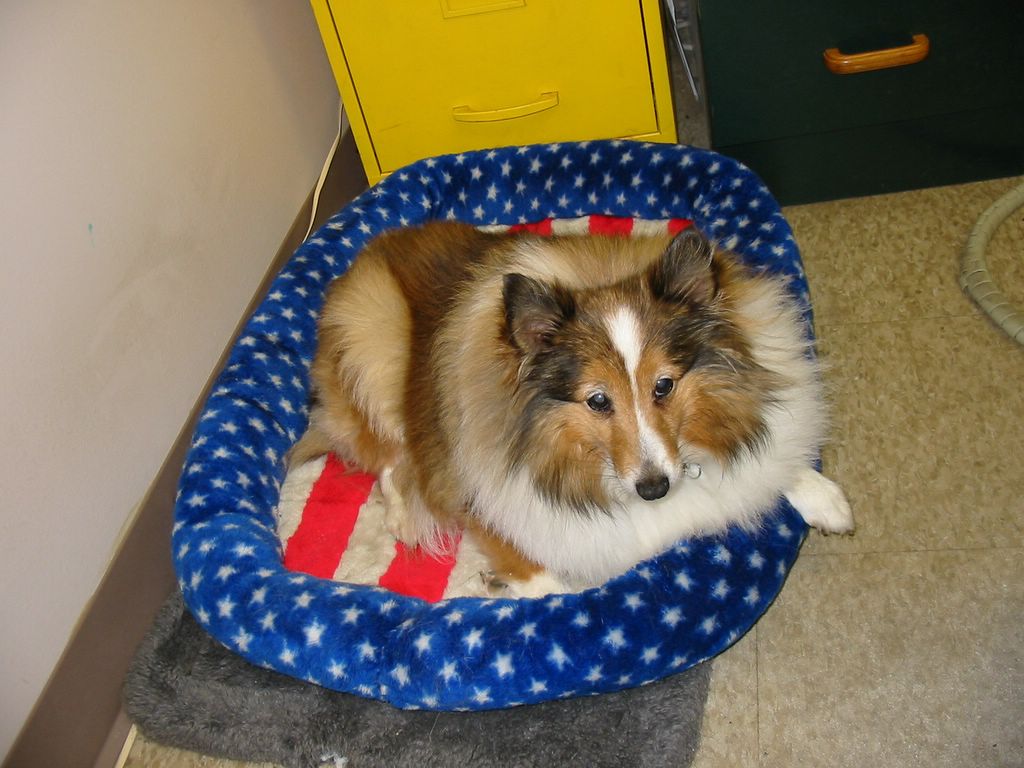
My Sheltie, Daphne, has an extremely thick coat. I don't shave her in the summer, because it's good insulation if she does walk through sunny areas, and besides it would be quite unattractive when it grew back. Coats that are meant to be long grow back thicker, usually dryer, and with less color. The result is a faded, unhealthy look. People who insist upon having their Goldens shaved in our grooming shop often complain about the quality of the coat come November. No amount of education seems to dissuade some owners - usually they are upset with us because the coat doesn't look great when it grows back!

Anyway, what I do with Daphne is shave her belly. It's called a "shell". You can't see that her skin is showing under there because of her long coat and it allows for excelerated cooling when she lies on a cool surface. At The Doggie Den we always recommend this in the summer for long-coated dogs. When Daphne and I are near a pool or other body of water, I dip her gently so her belly and bum get wet, and she loves it (though she positively hates water and will not go in by herself no matter what the temperature - it's a breed thing). She always trots around happily after her "dip".


Check out these dog links!

The Doggie Den Homepage
www.nadda.com (for dog day care owners)

Saturday, July 23, 2005

The Dog Days of Summer

The days are longer, the nights are warmer, and opportunities for dogs to play outside abound. Like us, our pets feel the changes of season and rush to meet them. But they don't always know how to tell us when they're uncomfortable, overheated, ill or injured; they rely on us to protect them from summer hazards.

Dogs have a harder time cooling themselves than we do. They release heat by panting, and by sweating through their paws; they don't have sweat glands anywhere else. On hot days, exercise your dog in the early morning or in the evening, and always carry water so she can drink frequently. In extreme heat, you can spray down her coat with cool (not cold) water before and after exercise. NEVER leave her in a parked car, even with the windows open. Every summer, we hear about dogs who die when exposed to the heat trapped in a car.

Keep your dog out of direct sunlight, and steer clear of asphalt, which heats quickly and burns paws. Don't shave your pet to the skin, as dogs sunburn easily and are as vulnerable to skin cancer as we are. Keep at least an inch of hair on longer coated pups. Fur actually keeps some dogs coooler, and always acts as a natural sunscreen. Before going outside, put sun block on his ear tips, his nose, and any other exposed areas.

And, oh by the way, please don't allow your dog to hang out of a moving car, especially the back of a pick up truck!!!

Check out these dog links!

The Doggie Den Homepage

Signs of Heat Stroke

In hot weather, watch out for these signs:

  • Heavy panting
  • Glazed eyes
  • Rapid pulse
  • Unsteadiness or staggering
  • Vomiting
  • A deep red or purple tongue

If you see these signs, take your dog to a veterinarian immediately!


Check out these dog links!

The Doggie Den Homepage

Wednesday, July 13, 2005

The Pleasures and Perils of Pools

Backyard pools are one of the joys of summer. However, we need to remember that they represent a drowning hazard to pets and wildlife alike; safety should be a priority for animals as well as people.

Not all dogs can handle water. Breeders and rescue groups will often refuse to place their dogs with families who have unfenced pools. Some breeds have a front heavy design (bulldogs, boxers, pugs) which makes swimming difficult, if not impossible. They can tire quickly and risk drowning. Even dogs who love to swim need to be supervised, and it's a good idea to teach them to go to the pool steps. It's safer for them and will save your pool liner! One person should be in the water with the dog, helping him toward the steps. Another person should be on the steps encouraging him in the right direction and offering a treat as a reward for using the steps.

Even the best intentions don't always keep gates closed to unsupervised animals, so the best solution is an exit ramp, such as the Skamper-Ramp. These ramps anchor to the side of the pool and are designed to attract animals. Once your pet steps onto the submerged end of the ramp, the ramp surface helps him crawl to safety. The Skamper-Ramp is available in pool supply outlets and online: www.skamper-ramp.com.

If your dog enjoys the pool regularly, remember to hose her off with fresh waterwhen she's done. Chlorine and other pool chemicals leave the coat sticky, and damage it over time. Dry, lifeless fur, dry skin, and rashes can be the result.

The Doggie Den Homepage

Saturday, June 25, 2005

Paws in the Park

On Sunday June 12th, Save A Dog held its annual fundraiser, "Paws in the Park", on the grounds of the VA Hospital in Bedford, MA. Save A Dog is an all-volunteer dog rescue based in Framingham that has found permanent homes for hundreds of unwanted dogs. The Doggie Den works with them to raise money.

It was a scorcher of a day - over 100 degrees in the field where vendors set up booths. Many breed rescues attended, including Boxer rescue, Greyhound Rescue, and Cocker Spaniel Rescue of New England. The Doggie Den donated a trainer (Janet) and equipment for the agility trials; and lots of folks contributed $5.00 for Janet to guide them through the various obstacles on the course. We all looked a bit like a wet t-shirt contest, as it was impossible to stay dry in the heat and humidity. Even the talented pups in the Blue Dog Group were slow to go into their frisbee dance act. There was lots of activity on the part of both dogs and people at the misting area and at the hoses. Some people just held a running hose over their heads! I bought a bottle of water, took a sip and poured the rest over the back of my neck. Heavenly!

There were various contests in the center of the field, including Best Dressed Dog; Best Dog Vocals; and Largest and Smallest Dog. I saw a well-dressed Cocker (in her flowered sun dress, matching visor, shoes and sunglasses) dart away from Mom to leap into a nice cool wading pool, one of many that Save A Dog had provided to chill out the pups.

Despite the heat, it was a rocking good time, and Save A Dog earned about $15,000, thanks to numerous contributors of food, equipment, and activities. If you live in Massachusetts or surrounding states, look for this event next year. It's really fun! We'll post it in advance on this blog.


Check out these dog links!

The Doggie Den Homepage

Monday, June 13, 2005

Fleas and Ticks: The Price of Good Weather

In the Spring, nature waxes abundant. But, ick! Fleas and ticks come along with the seasonal plenty. Be sure to protect your dog and your family by using a spot-on anti-flea and tick medication on your pup.

In New England, the ticks seem to be bent on repopulating the region. We pick them off our grooming guests every day (our day care guests are required to be treated with monthly medications). Massachusetts hosts several varieties: brown dog ticks, American dog ticks, and deer ticks (the tiny ones which may carry Lyme disease). When pup brings these ugly critters into your home, the ticks attach themselves to anything warm-blooded. An engorged tick then drops off its host and completes its life cycle. Which means your home becomes infested with tick eggs. Fleas will do the same, after biting your dog or your family.

All of this is fairly disgusting, as well as dangerous to human health. Fleas and ticks carry several diseases, the most common of which is Lyme disease, a bacterial infection that causes flu-like symptoms, rashes, arthritis, fatigue and neurolgic or heart problems. Lyme disease is life-threatening if it's not treated.

Pet stores and veterinarians carry monthly medications that you dribble onto your dog's skin between the shoulder blades. Check to make sure the medication breaks the flea and tick life cycle by killing the bugs AND their eggs. Other methods, such as flea/tick collars, are not as effective, because they don't render the dog's blood poisonous to the biting invaders.


Check out these dog links!

The Doggie Den Homepage

Wednesday, May 25, 2005

Dog Rescue Ban Leaves Thousands Vulnerable

This Spring, the Massachusetts Department of Agriculture issued a "cease and desist" order to prevent animal shelters and animal rescue organizations from bringing dogs into Massachusetts from out of state, and putting them up for adoption. The only alternative is to house imported dogs in regulated facilities (which the shelters and rescue orgs must buy, establish and maintain); and have them examined by a state-approved veterinarian. The order effectively puts dog rescue organizations out of business.

At The Doggie Den we work with Save A Dog, an all-breed rescue organization based in Framingham, MA. Like virtually all such organizations, it is staffed by volunteers and operates on an extremely tight budget that consists solely of funds that the volunteers raise. On their own time and money, volunteers drive to locations where distressed dogs are being held, and bring the dogs back to Massachusetts. The new arrivals live in volunteer foster homes while they are vaccinated, treated for health problems, and trained so they'll be adoptable. The Doggie Den and other grooming shops groom rescue dogs for free, often to diagnose the extent of coat and skin ailments that may require the volunteer foster parent to take the dog to a vet.

This entire process takes years of organizing, fund raising, skill acquisition, and volunteer training. The D. of A. order sent hundreds of hard working volunteers into shock. It meant that years of dedication were cut short; and speaking of cut short, we cannot help but think of the thousands of animals currently dying of starvation, disease, dehydration, or euthanization because Mass. rescue workers cannot save them. The reason for the D. of A. ban is that unethical opportunists go to states that are known for their plethora of unwanted dogs and bring the dogs back to Massachusetts to sell them. These people often neglect to provide new arrivals with medical care, nutritional support, or training. Their neglect has caused multiple problems, including the discovery of locations where large numbers of sick animals have been abandonned. It falls to the Commonwealth to euthanize these poor creatures.

Within Massachusetts, there are comparatively few adoptable animals to be rescued. In contrast, in some areas of the South there are thousands. To save lives, dog rescue organizations must be able to bring animals in from out-of-state. The only organizations that are currently permitted to do so are established shelters that have facilities that the Mass. D. of A. can inspect, rather than volunteers with adoptable dogs in foster care. Ironically many shelters are less stringent than volunteer rescue orgs. in checking out potential new owners. Rescue orgs. often do home visits, which shelters seldom do. Some state-approved shelters also euthanize dogs that have not been adopted, while rescue volunteers foster, vaccinate, heal, and train dogs until the dogs become adoptable.

Many rescue organizations like Save A Dog are now scurrying around to raise enough money to buy an inspectable facility where new arrivals can be held for adoption. Of course, this is a major undertaking, and some groups will not succeed. If you can help, please do! Rescue organizations need supplies, skills and money. Go to saveadog.org; or any one of a number of breed rescue sites like pugrescuenetwork.org; greyhound.org; and ygrr.oprg (Golden Retrievers). Also check out Especially for Pets in Westboro; The Buddy Dog Humane Society in Sudbury; or the Bay Path Humane Society in Hopkinton.
Thursday, May 12, 2005


Daphne can't watch TV anymore since she saw the (gulp) debarked Shelties Posted by Hello

Janet doing behavioral therapy with Nervous Benny Posted by Hello

Wednesday, May 11, 2005

Debarking? Huh?

Every once in a while I see something about dogs online or on TV that makes me crazy. For example, I never watch America's Funniest Video's because the one time I did, they showed shots of dogs having weird accidents. It looked to me like the dogs were hurt, though not seriously. I was furious, then I saw that they do the same thing with children! There were scenes of toddlers falling down steps and, in one case, into a swimming pool. The audience thought it was hilarious. So a parent can earn thousands of dollars showing their kid having a funny accident. In several of the entries, the child was crying at the end. Guess I shouldn't be surprised that dogs were fair game.

Then the other night I saw a major network feature on debarking dogs. At first I thought it couldn't be what it sounded like. But... lest we not have a clear picture, the producers showed dog after dog having their vocal cords cut or otherwise damaged, as with a laser. Per the usual network practice of "balancing the story", we heard from those who were in favor of this practice, as well as those who were against. Didn't help, as far as I was concerned. One of the dog owners was a Sheltie breeder who had had consistent complaints from neighbors because of barking. So she debarked her dogs! I watched 20 seconds of Shelties in her back yard opening their mouths to emit a sound that resembled a sick cough. Daphne was appalled. She slunk out of the room, looking over her shoulder at me in unmistakable rebuke. I felt ashamed for humans.

Debarking involves cutting the vocal cords, or otherwise impeding their vibration. The dog is anesthezied, then an incision is made under his/her chin. It only takes minutes. Whoopee for efficiency. And the neighbors don't complain... how nice. This practice is barbaric!! It reminds me of another century when prison guards cut peoples' Achilles tendons to prevent them from bolting. It's just one example of the lengths people will go to to avoid the work of training their faithful companions. People will use electric shocks; collars that spray stinging fluids like citronella in their eyes and mouth; prong collars with barbs that dig into the flesh of the dog's throat and damage his/her esophagus; and now surgery, rather than teach the dog how to live with humans. Sorry, but there's no excuse. It's sheer laziness, not to say the need for instant gratification. Would you use a citronella collar to stop your 3 month old daughter from crying??? Would you put barbs around the neck of a toddler who constantly pulls away from you and gets herself into trouble?

I know, dogs are not children. But they are mammels with nerve endings and they hurt. It's just that they don't always show that they're in pain. So a Rottweiler with a prong collar who's dragging his master down the street doesn't look like he's hurt. If it hurt, he would stop, right? WRONG! Lots of dogs don't make the connection between pain and bad behavior. Almost all dogs can make a connection between good behavior and rewards. So why doesn't the guy teach his Rottweiler to walk nicely by giving him lots of hugs and treats when he does well?? It's just too hard, I guess. And then there's the issue of guys and macho dog breeds, but we'll leave that for another post.

The argument was made that some people would have to put their dogs down if they didn't cut their vocal chords. One judge even ordered a dog owner to have it done or euthanize the dog. Thank heavens, that judge no longer issues such orders because someone showed him exactly what's involved, and it repelled him. He now orders people to train their animals or give them up for adoption. Anyway the argument is ridulous. If you can't or won't take the time and effort to teach your dog not to bark, then give your dog to someone who will. Get help!! (from a trained canine behaviorist). It'll cost maybe the price of a dinner for two and a movie.